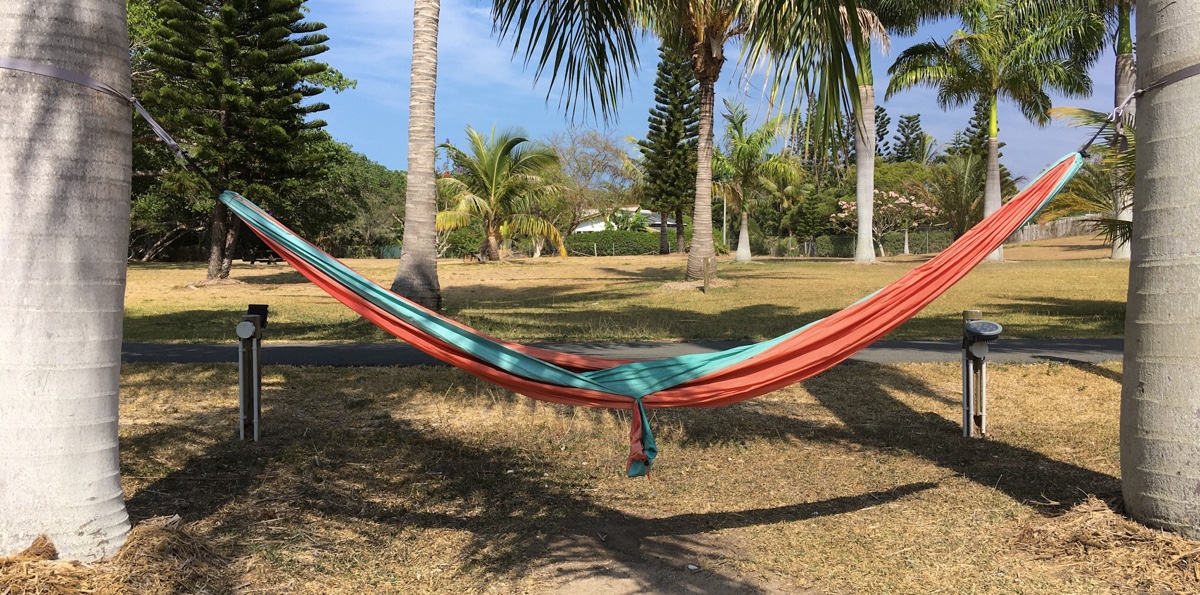
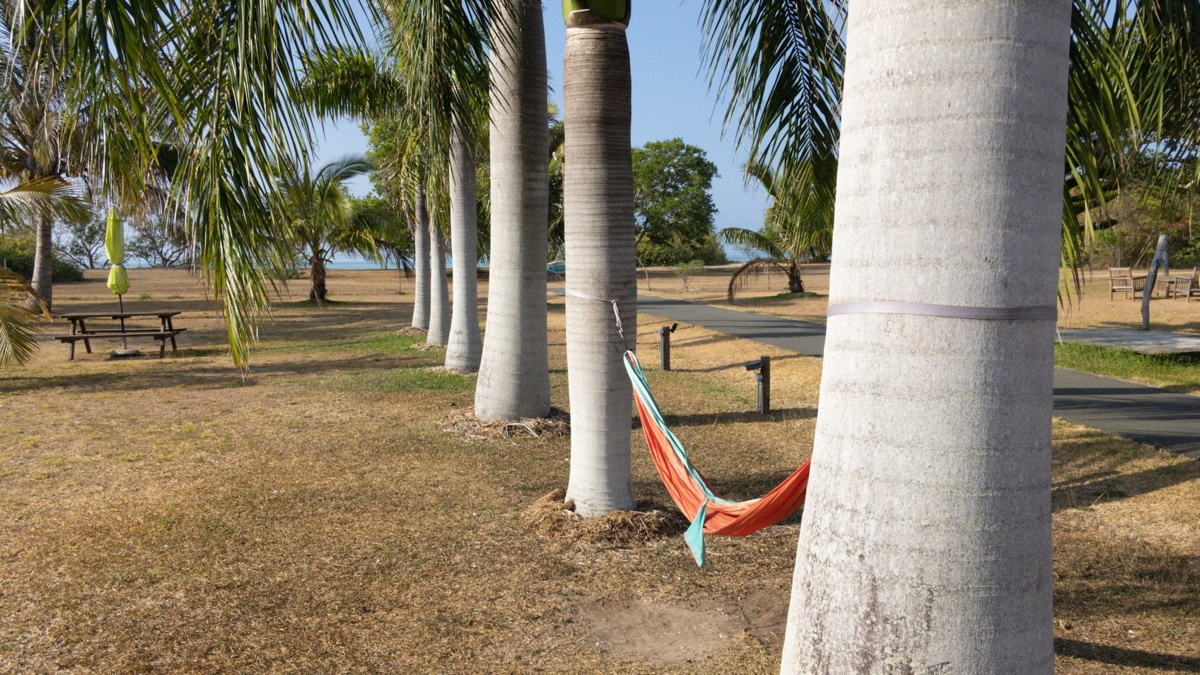
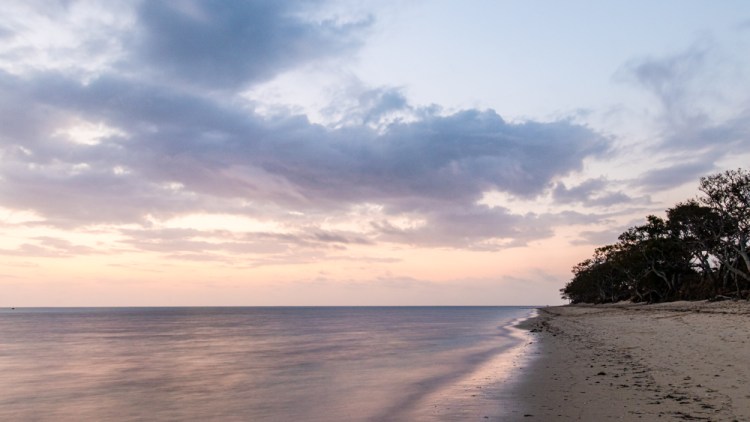
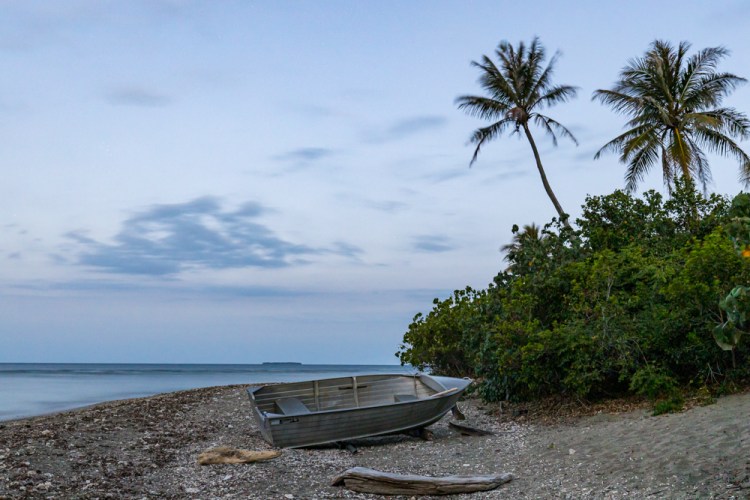
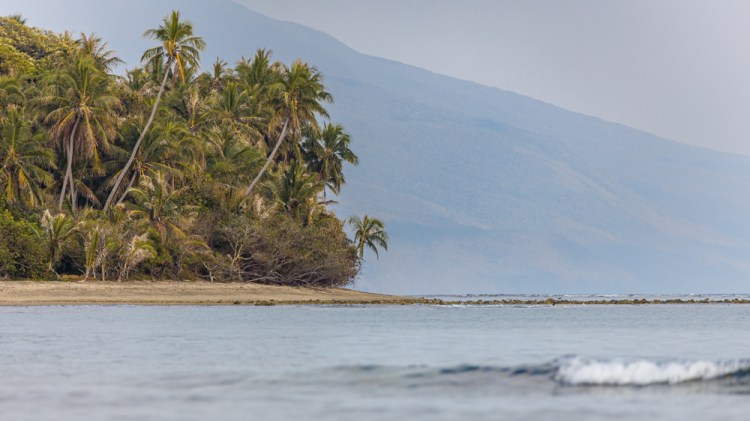
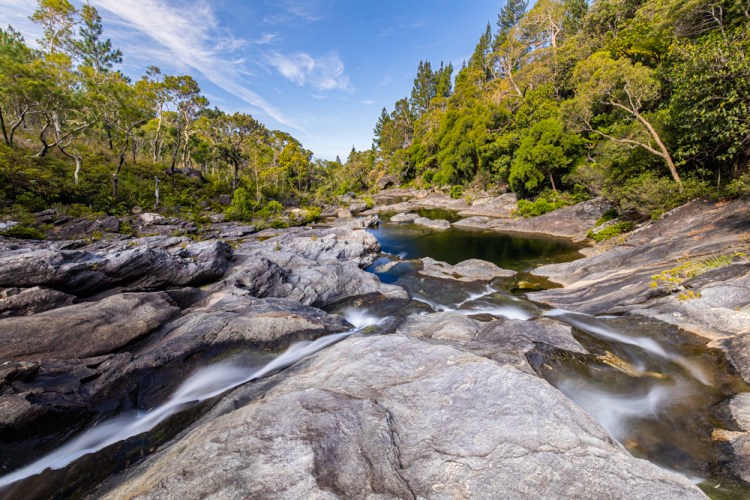
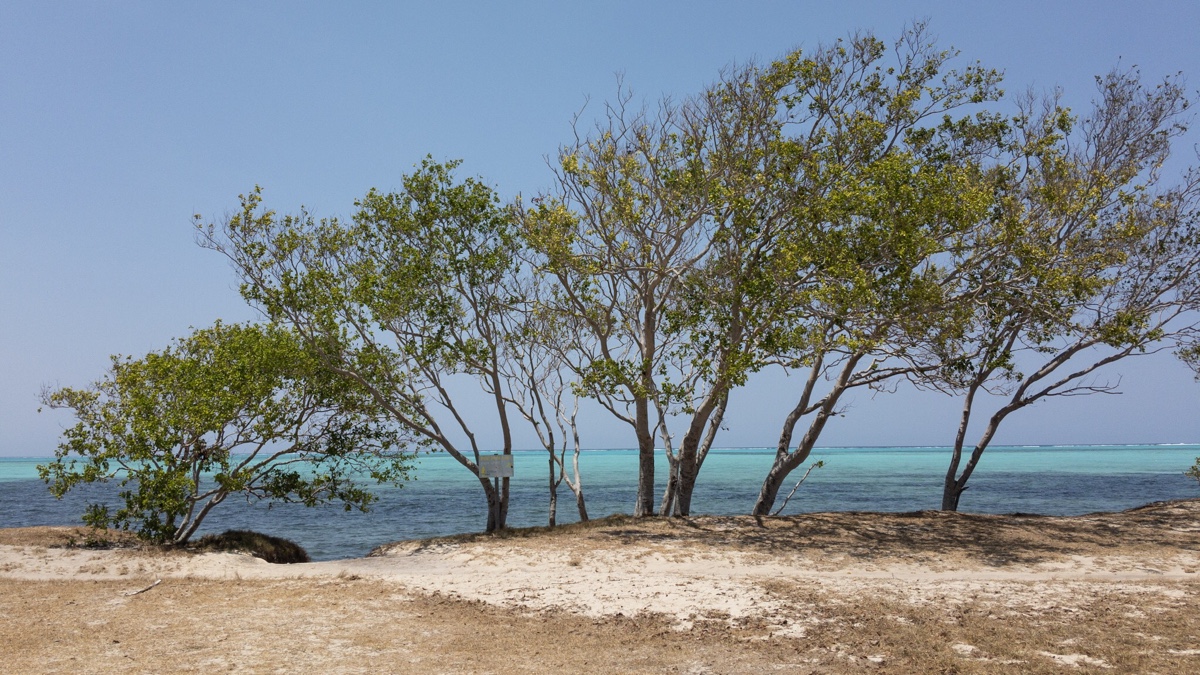
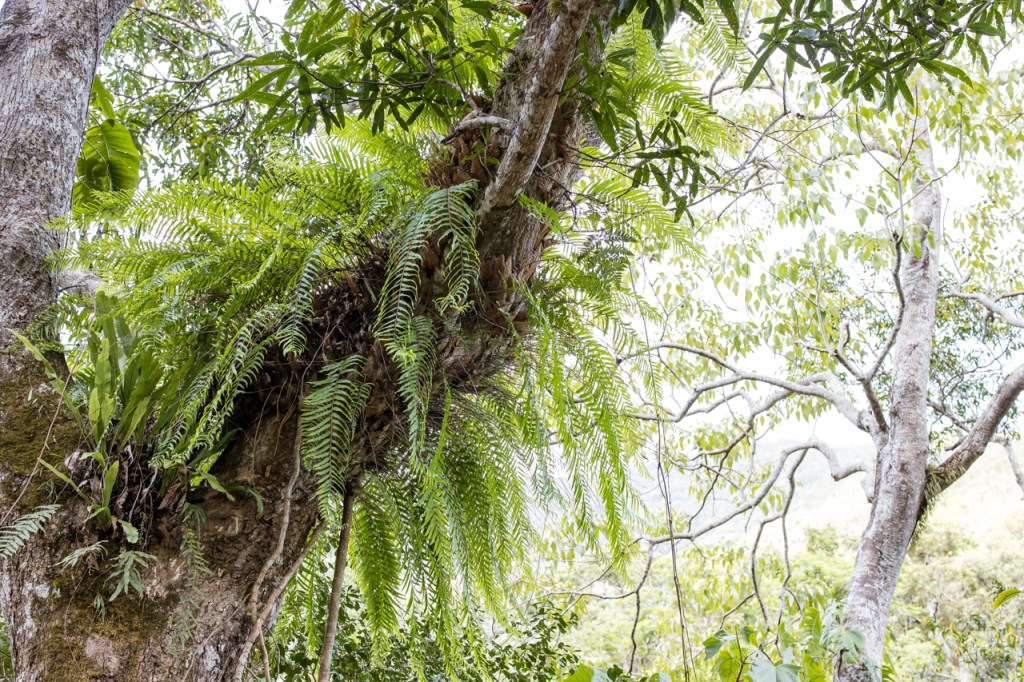
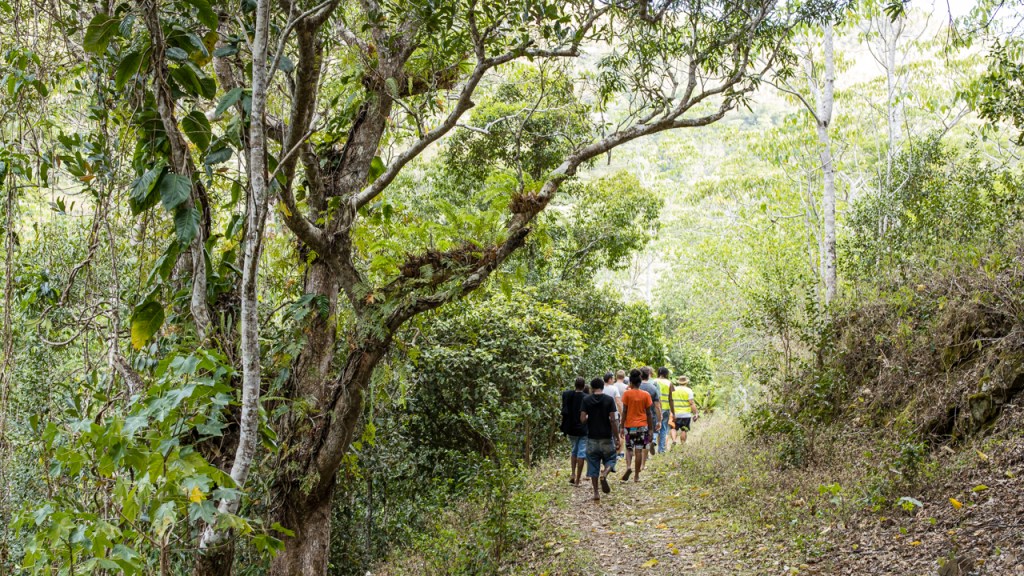
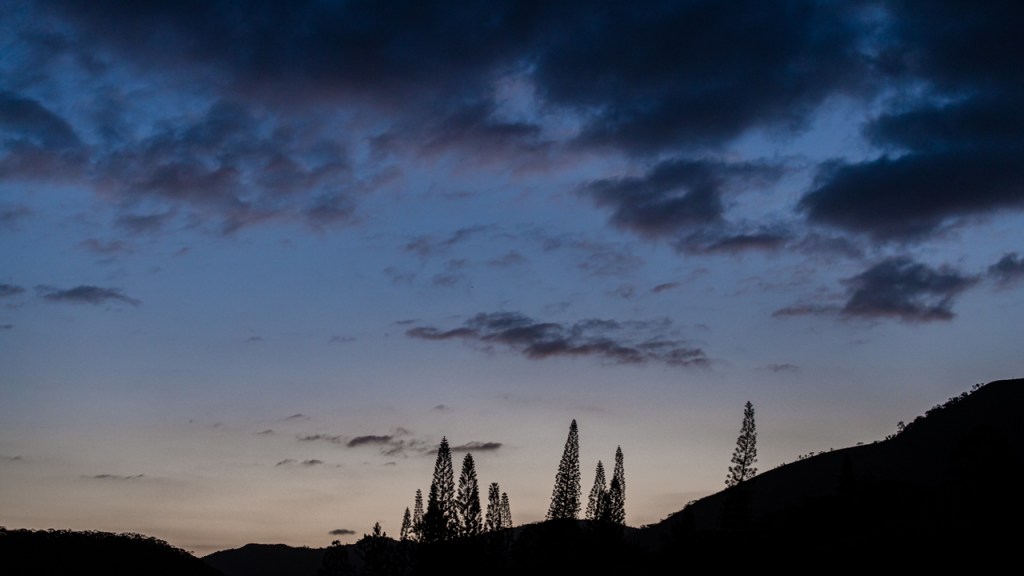
I need a hammock. That’s basically all there is to say.
I need a hammock. It’s not about me wanting one, no. It’s essential. A MUST, as they say in French (and I hope you’re getting the pronunciation right here).
And don’t get me wrong: I don’t demand palm trees. Or 30 degrees Celsius in December. Nor a view of the turquoise sea in the distance, where the waves are crashing at the coral reef.
All I’m saying is: … Well, I think I’ve made myself sufficiently clear by now.
In case you’re wondering where I took these pictures and (more importantly) where I had this lifechanging insight: the hammock can be found at the Auberge de Jeunesse (youth hostel) in Bourail-Poé. I cannot recommend this place highly enough!
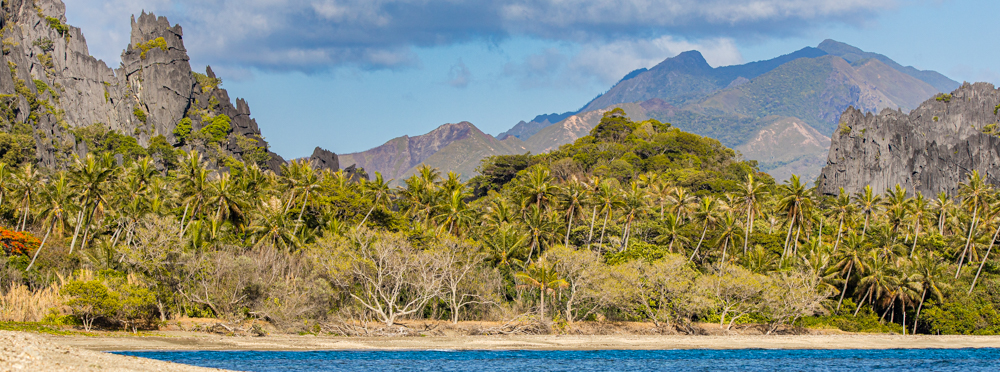
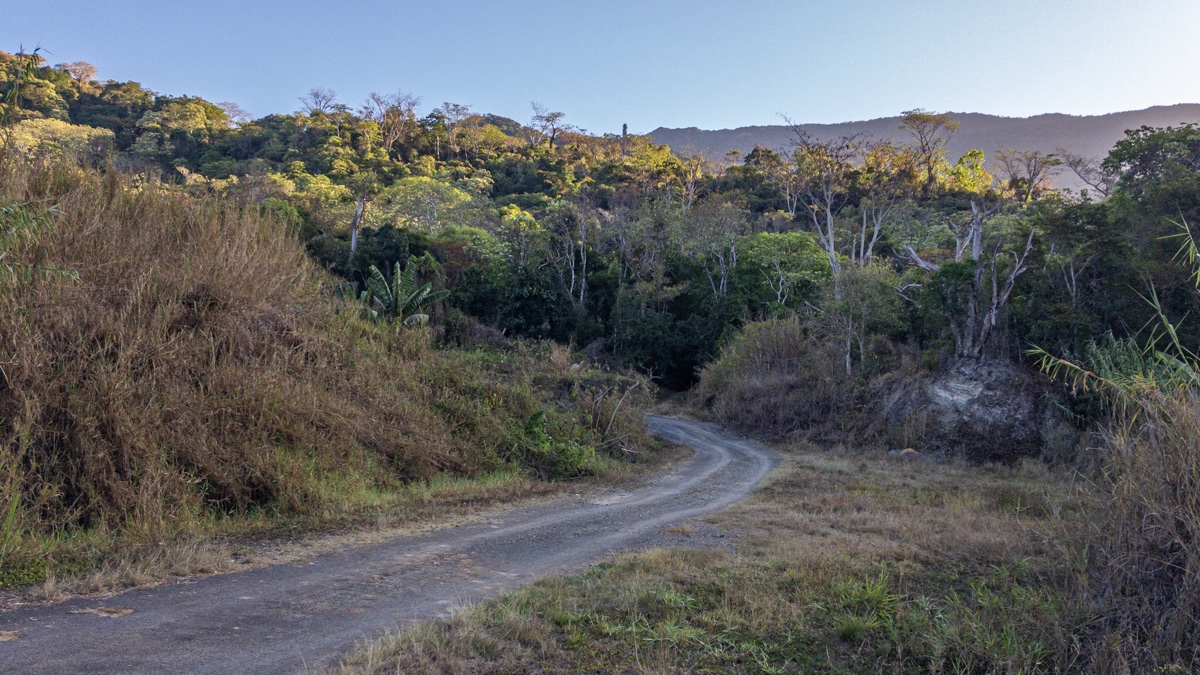
Having spent the last ten days or so in New Caledonia, I have managed to travel a bit and to see some corners of the main island, Grande Terre. I guess it’s time to share some classic, old-school landscape shots with you, okay maybe with one or two exceptions.
They aren’t in any particular order, and don’t expect tons of commentaries and explanations. Are you ready?
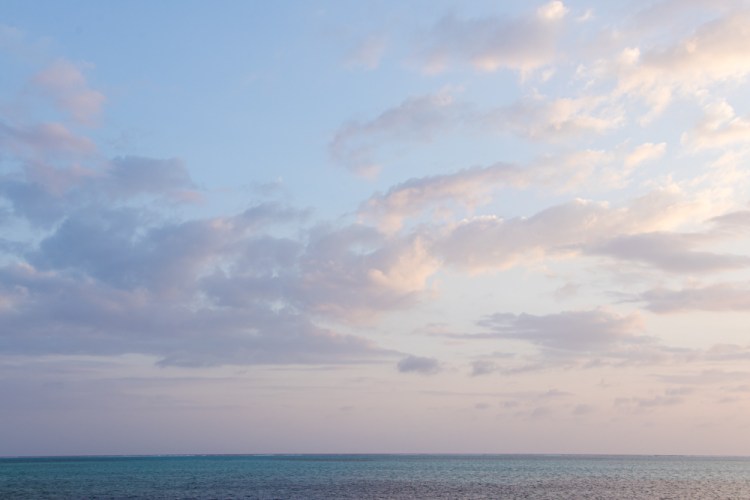
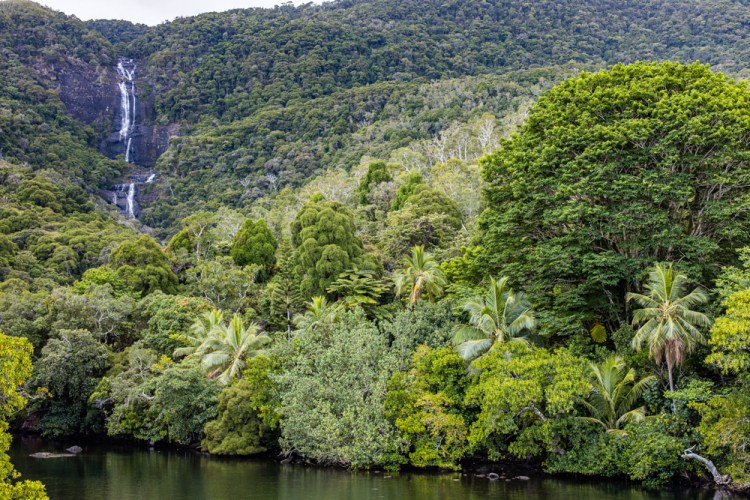
The sea, of course. (Wait a minute, is this a classic landscape photo?)Again, the sea. Again, some question marks as to whether this constitutes a landscape. What you can clearly see, though, is the fact that it’s not all palm trees here!Ah, classic at last.Sadly, this is a very common sight on Grande Terre. Mostly the result of man-made fires, and aggravated by the immense drought they have been having here in recent months (and even years). And environmental disaster for sure.Man-made? Yes. Classic? Why not!Ditto. Downtown Bourail. Am I in the wrong movie?A typical view in “la brousse”, the central part of the West Coast of Grande Terre. These are mostly cattle pastures, and the trees are amazing.At Koulnoué Plage near Hienghène.Also at Koulnoué Plage near Hienghène, East Coast.Yes, still Koulnoué Plage near Hienghène.Cascade de Colnett, north of Hienghène.Cascade de Tao near Hienghène viewed from the coastal road (‘la Corniche Calédonienne’). The eastern part of Grande Terre is soooooo much greener and more beautiful, actually, than the western half.Looking down on Hienghène and the bay.La Poule Couveuse. Do you see the chicken?Once more, the beautiful coast around Hienghène. Definitely worth the trip!The ‘pointe de vue’ high above Hienghène and Koulnoué. They should really consider to chop down at least some of those trees in the foreground (seriously!). I mean, why build such a magnificent and well-maintained viewpoint, and then let vegetation obstruct and/or block the views? I was rather frustrated there that evening, I can tell you…Sunset at plage de Poé near Bourail.
Thanks for viewing these pictures, and do stay tuned!
During the first ten days of my stay here on New Caledonia (Grande Terre), I’ve already had the pleasure of seeing a number of different bird species. Some of them are endemic to the archipelago, which means they cannot be seen anywhere else in the world. Others, on the other hand, shouldn’t be here at all. They were introduced by humans and sometimes make life rather difficult for the indigenous bird species.
Then let’s take a look at some of them, shall we?
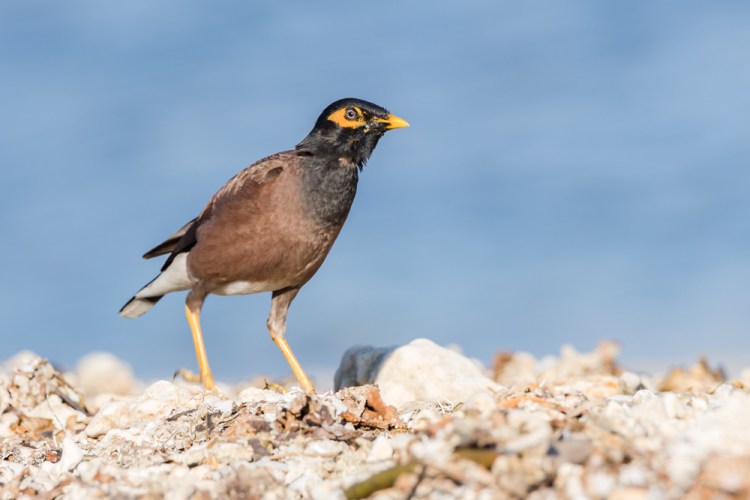
The aptly named common myna (Acridotheres tristis, Hirtenmaina, Martin triste / Merle des Moluques) is such a bird that shouldn’t be here. I’ve heard that it was introduced by farmers in order to fight agricultural pests.
It is by far the bird that I see most frequently – not in woodland and forests, but everywhere else in developed areas and along roads and beaches. And it is quite noisy, too! And suprisingly shy, despite its abundance. I don’t like them.
The next little bugger is also one that wouldn’t be here had it not been for the intervention of humans: the house sparrow (Passer domesticus, Haussperling, moineau domestique). Well, at least it’s good to know that there are some left in the South Pacific while their numbers are declining in Europe…
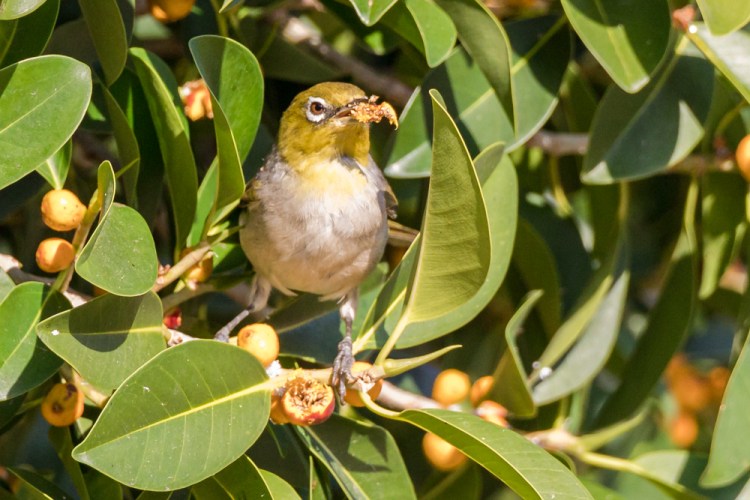
Ah, a proper New Caledonian bird at last, and even an endemic one: the green-backed white-eye (also known as the New Caledonian white-eye, Zosterops xantochroa, zostérops à dos vert – no German name, as far as I know).
These guys are really cute! You see them a lot. They are small and constantly on the move in trees and bushes or on the ground, they almost never come alone. Fortunately, they are not really shy, so it’s usually easy to observe them.
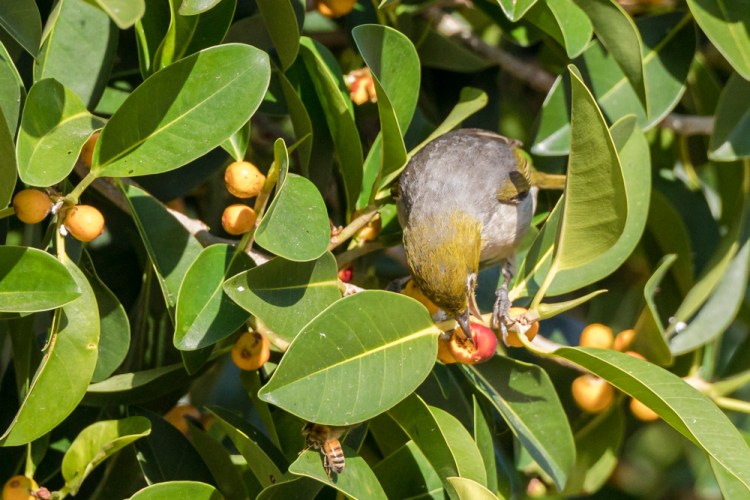
Another species from the Zosterops genus is the silvereye (Zosterops lateralis, Graumantel-Brillenvogel, zosterops à dos gris). So far I have only seen it in one location, namely plage de Poé near Bourail.
Not a rare bird, according to the literature. But of course one has to look quite closely in order to distinguish the two species…
The rufous whistler (Pachycephala rufiventris, siffleur itchong) is one of these birds that you usually hear before you see them.
It is not uncommon, and I like it.
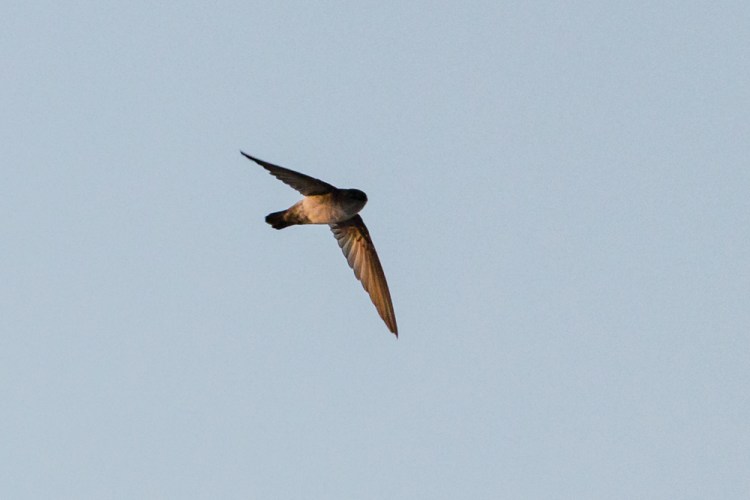
Always in the air and on the move are the two species of swiftlet here in New Caledonia. This one is the white-rumped swiftlet (Aerodramus spodiogygius, Weißbürzelsalangane, salangane à croupion blanc). I have seen it in the region of Bourail, where it was really common. A related species is the tiny glossy swiftlet (Collocalia esculenta, Glanzkopsalangane, salange soyeuse) which is really common in and around woodland. And virtually impossible to photograph, at least for me…
The following bird is the striated starling (Aplonis striata, stourne calédonien – German name?).
It is a bit similar to the European starling, but the male has a beautiful red eye. I used to think they were rare, but now I see them in many different places.
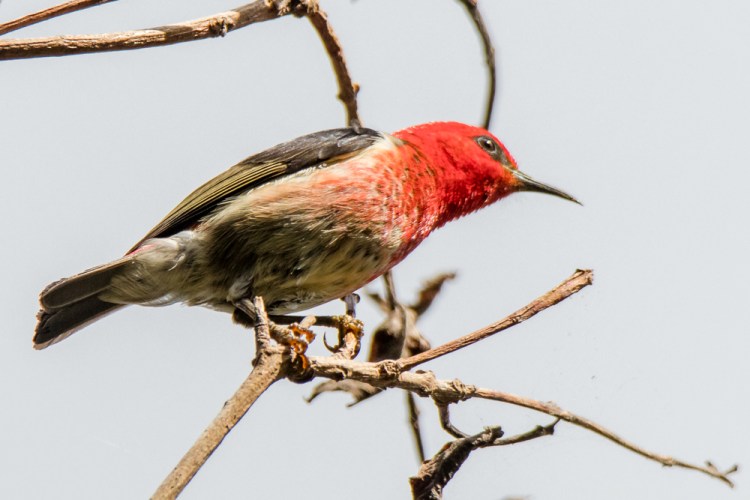
A real beauty is the cardinal myzomela (Myzomela cardinalis, myzomèle cardinal – German name?). It is much smaller than it seems on this photo.
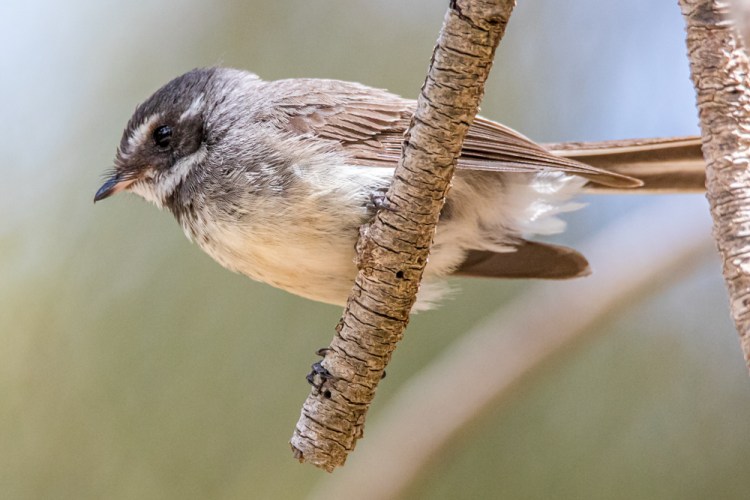
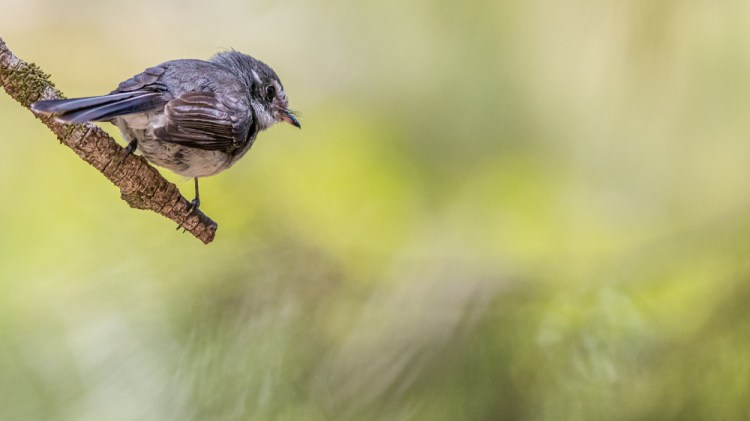
Another really common bird is definitely the grey fantail (Rhipidura albiscapa, Graufächerschwanz, rhipidure à collier / petit lève-queue):
It is not shy at all, and sometimes comes even too close to be photographed!
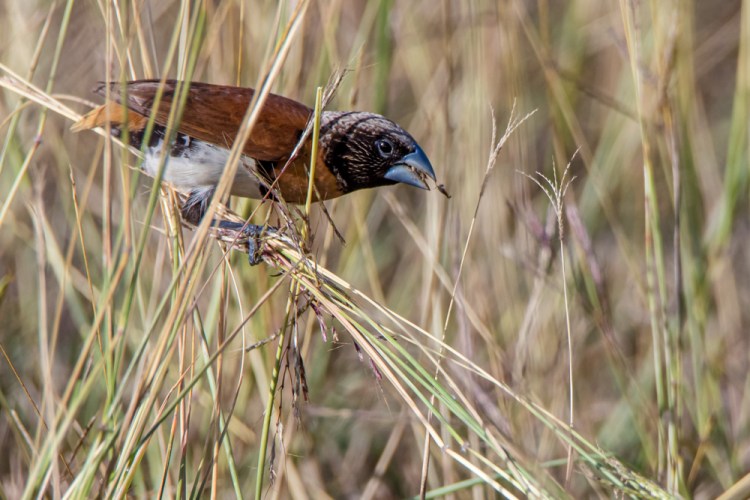
Another representative from the category “birds that don’t belong here”: the chestnut-breasted mannikin or munia (Lonchura castaneothorax, Braunbrustnonne, capucin donacole). It think it is really beautiful and it always makes me happy to see it. This species inhabits meadows and other types of open farmland, and they seem to always occur in flocks.
Oops, I almost forgot the honeyeaters! This cannot be. So here is the commonest of altogether three species found on New Caledonia: the grey-eared honeyeater (Lichmera incana, méliphage à oreillons gris / suceur, Grauohr-Honigfresser?).
I really like this species, even though it may not be anything ‘special’. But it sings quite beautifully and has a great silhouette, I think.
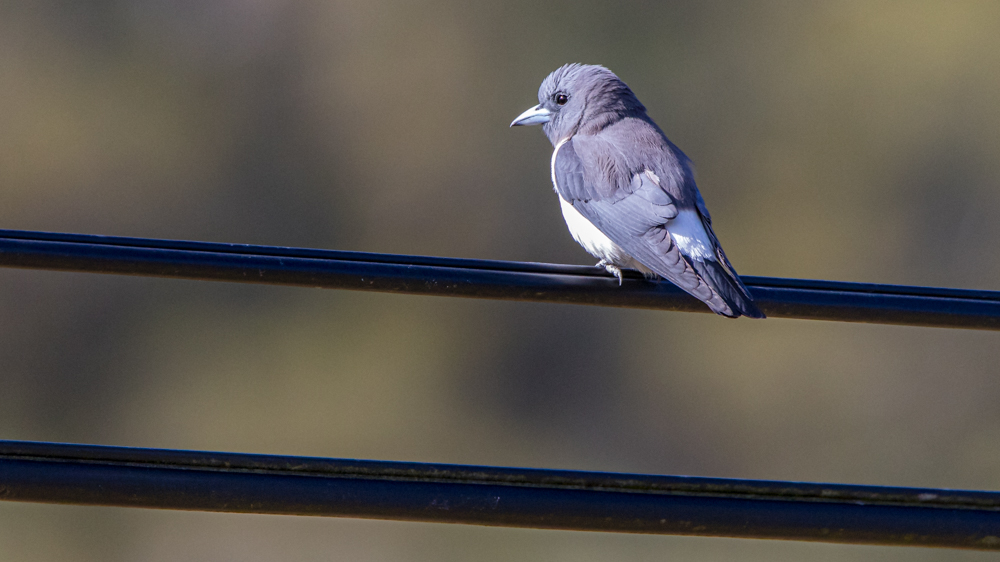
Speaking of ‘nothing special’ – the white-breasted wood-swallow (Artamus leucorhynchus, Weißbauch-Schwalbenstar, langrayen à ventre blanc) is quite similar in this regard.
It is a striking bird and can be seen a lot in gardens, on roadside etc. Often perched on powerlines, and almost never alone. They are really neat, I wish we had them in Europe!
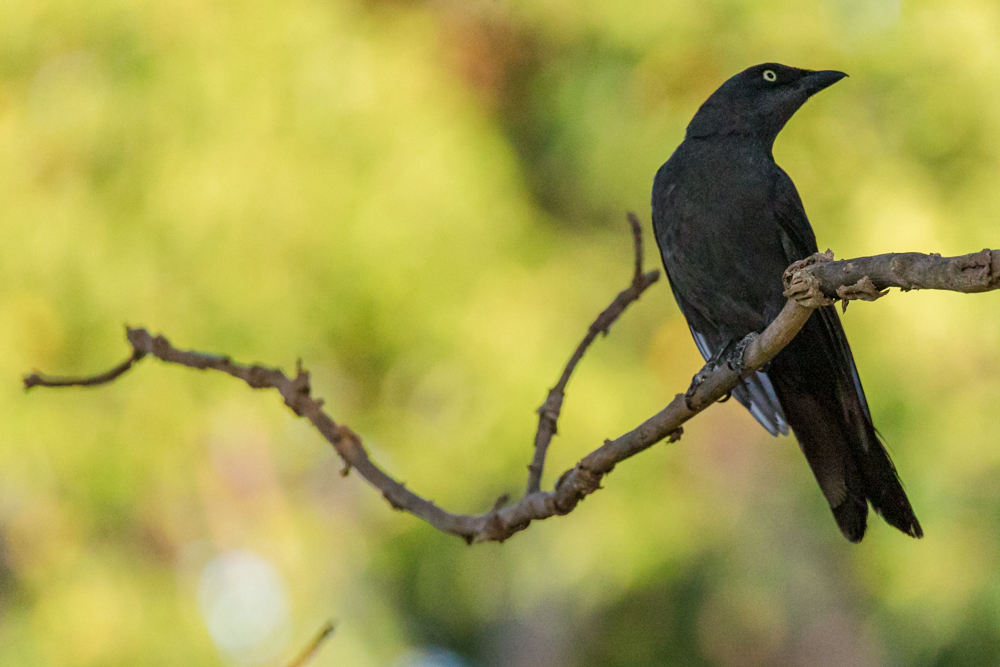
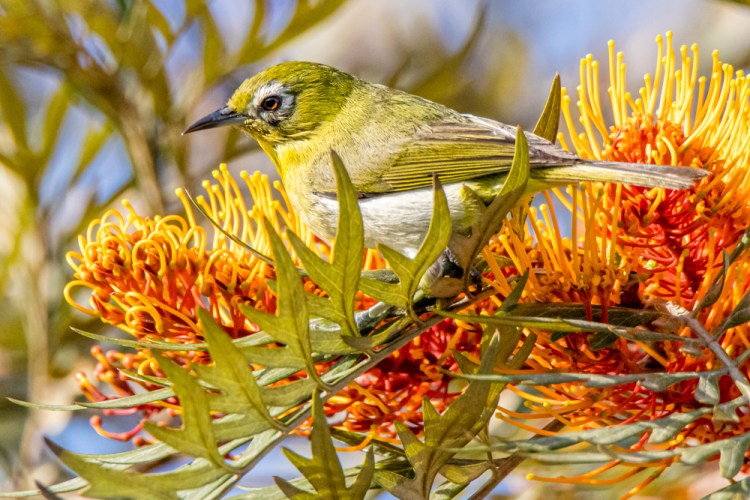
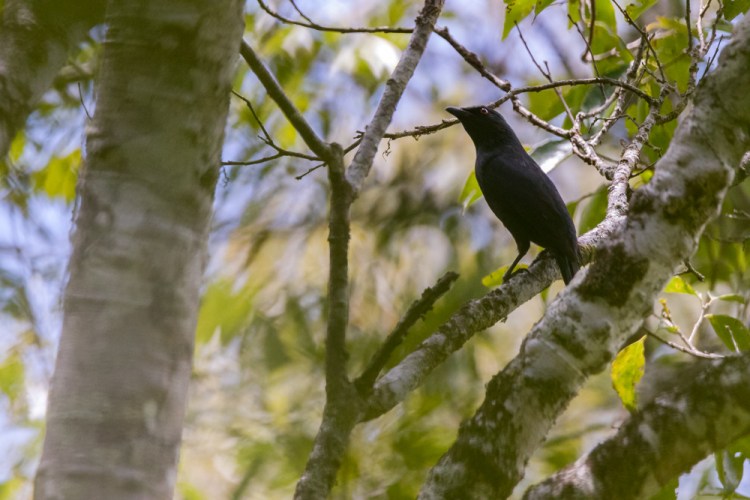
The South Melanesian cuckooshrike (Coracina caledonica, échenilleur calédonien – German name?) may look a bit like a crow, but does not belong in the corvid family (see below). It is not rare, but often hides well in trees and bushes. It is also depicted in the photo at the top of this blog post.
The New Caledonian friarbird (Philemon diemenensis, polochion moine – German name?) is, ummmm, a bit less beautiful than other bird species shown here…
It is common and conspicous, almost always calling and moving about in trees and bushes. And, to be honest, I think it is really ugly… (I never thought I’d ever say that about a bird!). The body is somehow disproportionate, especially the head with its spiky feathers that look a bit like hair. Like a small vulture somehow. Um, okay. Can we move on to the next species now, please?
Oh yes, the pigeons and doves. There are a number of spieces on New Caledonia, and some of them are really beautiful. However, they are more often heard than seen, let alone photographed…
By far the commonest species is the spotted dove (Spilopelia chinensis, Perlhalstaube, tourterelle tigrine), an introduced and very widespread species (above).
Way more difficult to observe is the stunning cloven-feathered dove (Drepanoptila holosericea, Spaltschwingentaube, pigeon vert). It is endemic to New Caledonia. When it beats its wings in flight, there is this wonderful sound, a bit like a little bell. I have heard that this dove is highly regarded by the local Kanaks. Apparently it brings luck to see one. Good!
Another really cool pigeon is the metallic pigeon (Columba vitiensis, Weißwangentaube, pigeon à gorge blanche). Again, surprisingly hard to see and photograph. Compared to the pigeons I am familiar with from Europe, this birds here are relatively shy. Maybe that’s because of hunting?
Oh and there’s parrots too, of course! So far I have been able to see the lovely horned parakeet (Eunymphicus cornutus, Hornsittich, perruche cornue) (no photos, unfortunately) and the loud coconut lorikeet (Trichoglossus haematodus, Allfarblori, loriquet à tête bleue).
Again, I have noticed that these parrots are rather shy. Even when they sit high up in a tree top, and I am far below them on the ground, they will still become really nervous and then fly away at some point.
And now, finally, the star of the New Caledonian avifauna, the world’s smartest bird!
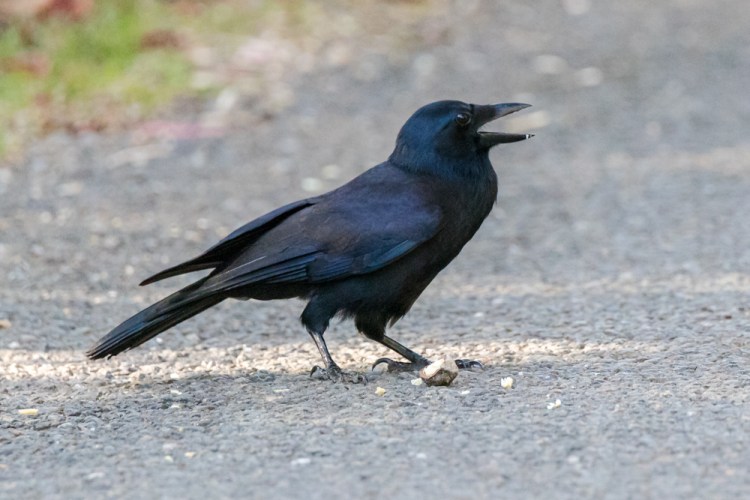
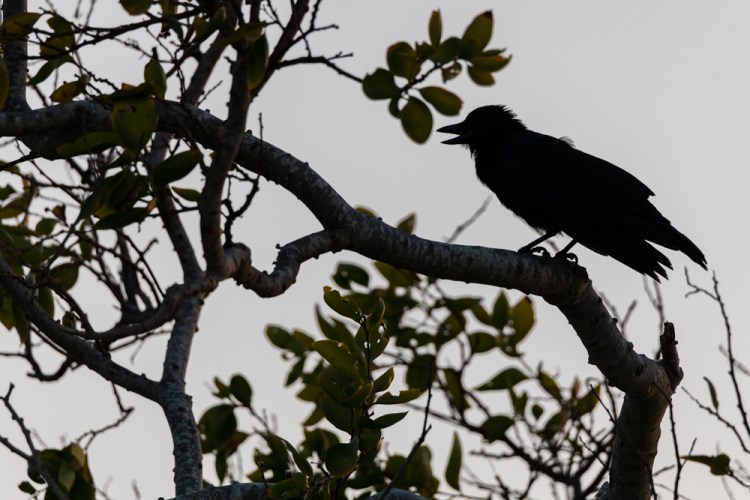
The New Caledonian crow (Corvus moneduloides, Neukaledonische Krähe, corbeau calédonien) is the only member of the corvid family here in the archipelago. It is said to be able to make its own tools in order to reach food (e.g. grubs from rotting tree trunks). The only things I have observed so far where one bird with a little stick in its bill to probe for food in the ground, and another that dropped nuts on a tarmac road in order to crack them. They are very cool indeed, but also rather shy. I’d love to take better pictures of them…
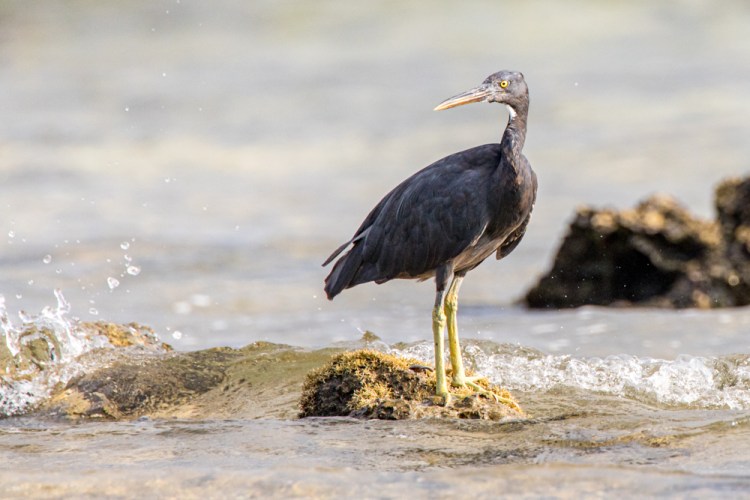
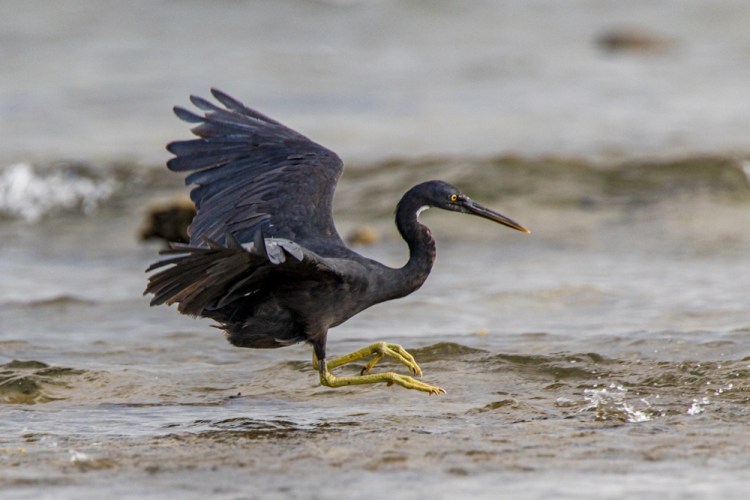
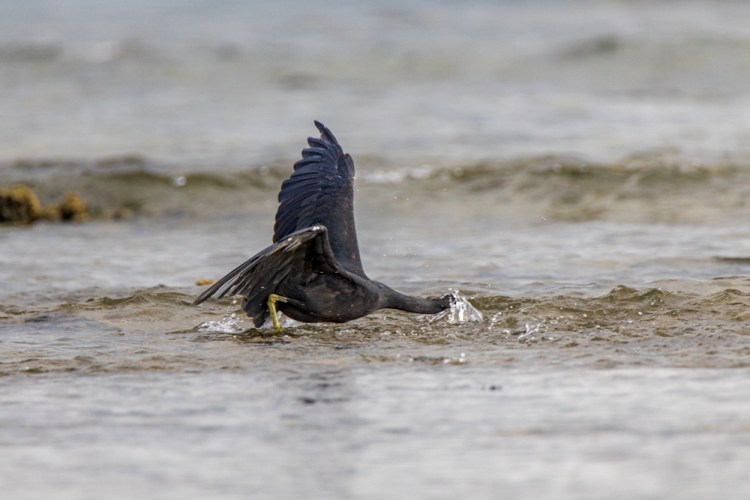
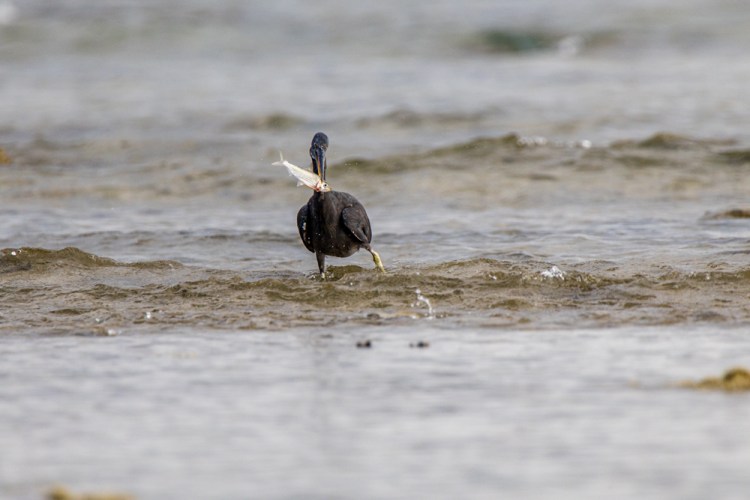
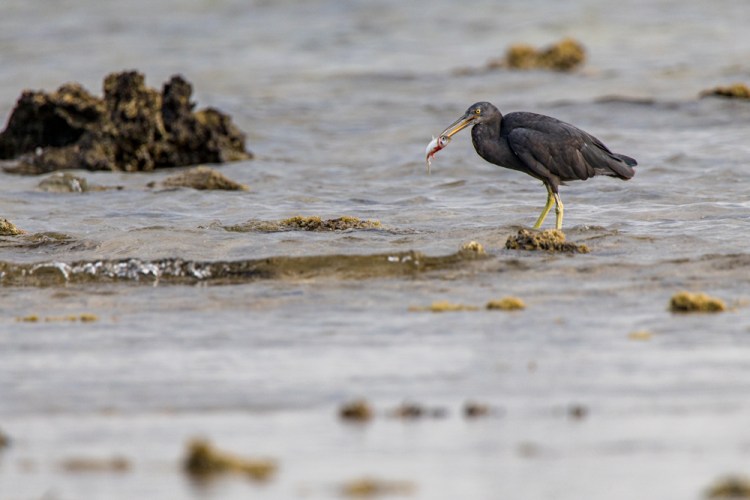
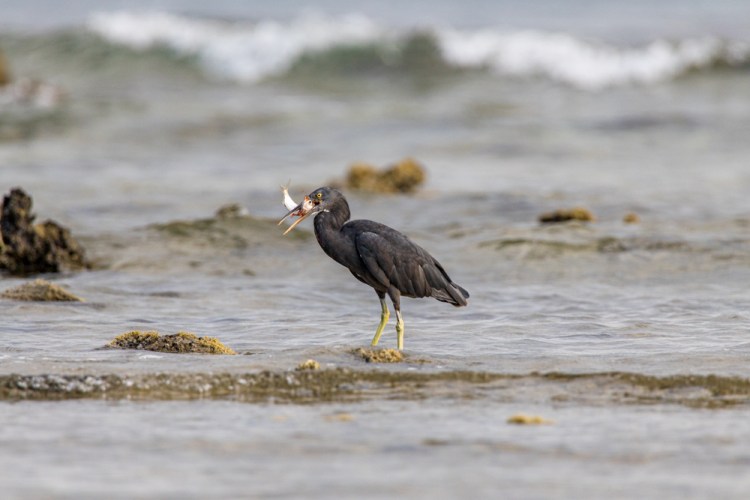
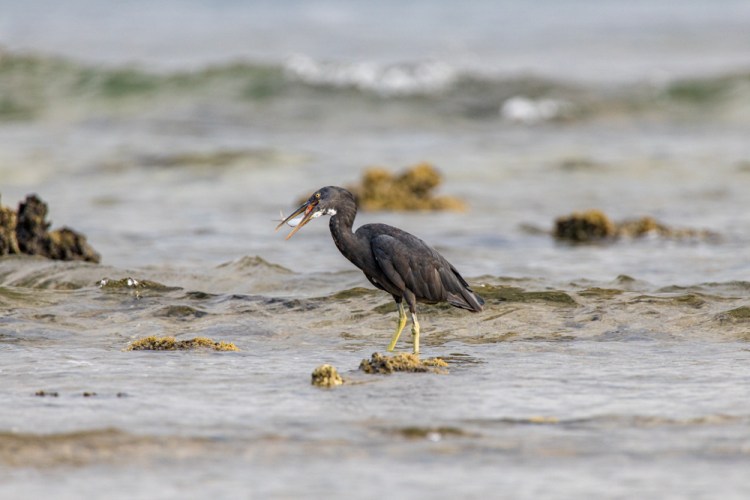
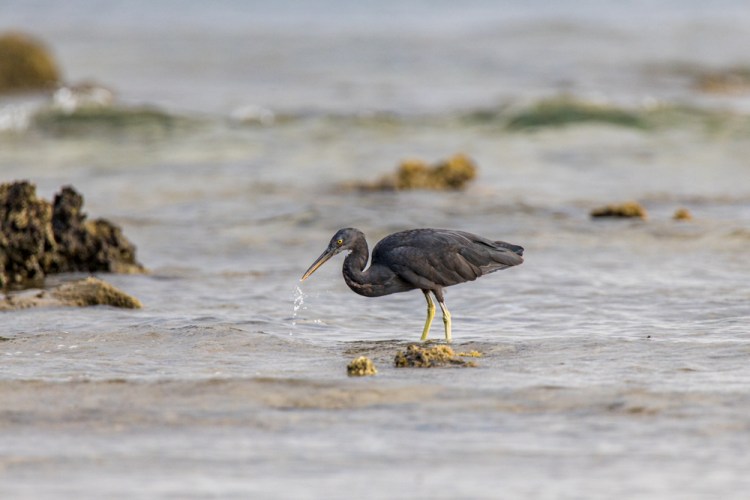
This is the sad story of a fatal encounter between a hungry heron and a fish. Well, sad for fifty percent of the protagonists… All others were quite content, as one can assume.
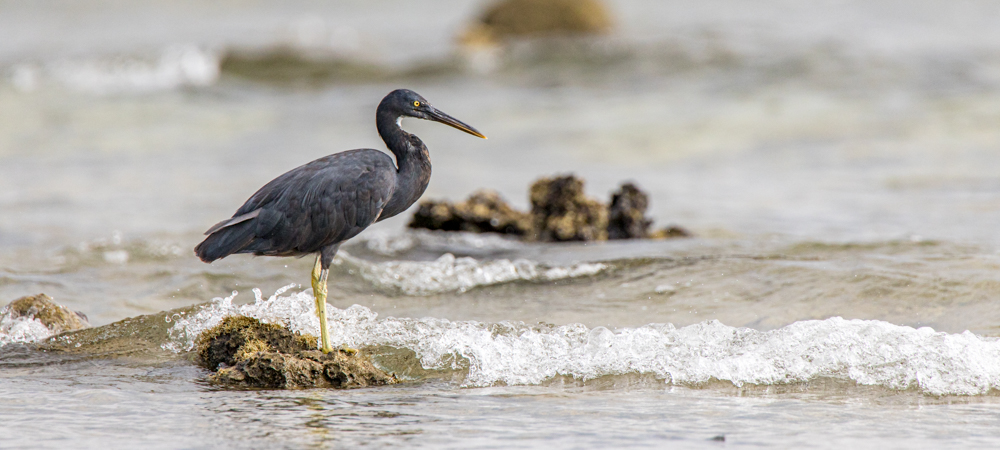
The Pacific reef heron (also known as the Pacific reef egret, Egretta sacra, Riffreiher, Aigrette sacrée) is a very handsome bird. I have seen it in several places on the coast already, always in the dark morph. There is also a purely white form, but it is much rarer than the grey one. It is not shy, which made it easy for me to photograph. The story I want to relate to here happened yesterday morning (3 December 2019) at Koulnoué Beach in the northeastern part of Grande Terre (New Caledonia).
May the images speak for themselves.
Yum-yum!
(Click here for more bird-related articles on this travel blog).
You might know that AA stands for the Automobile Association of Great Britain, the UK’s largest motoring organisation. And then there’s AAA, of course, the American Automobile Association, a federation of motor clubs throughout North America.
But AAAA?
I admit that, until very recently, I also hadn’t the faintest idea that this could possibly be more just than the most natural vowel times four. Oh but there is, believe me!
On my way from Farino to Poé plage two days ago I made a little detour to the town of Bourail. I just wanted to check wether there was anything interesting that I should take a closer look at. And besides, it’s always useful to know the shops, the snack bars, the gas station etc. in your vicinity, and their opening times. Then I saw the following “affiche”:
Ah, now the title of this blog post makes sense at last: so AAAA stands for the “Association des Arabes et Amis des Arabes de Nouvelle-Calédonie”. In other words, the Association of Arabs and their friends in New Caledonia. That sounded interesting. In my Lonely Planet guide book I had already read a little piece of information that there is to this day a small Arabian community in this part of New Caledonia. They are descendants of former prisoners who had been sent off to the South Pacific for various reasons in the nineteenth century. And now this! I decided to come back the next day.
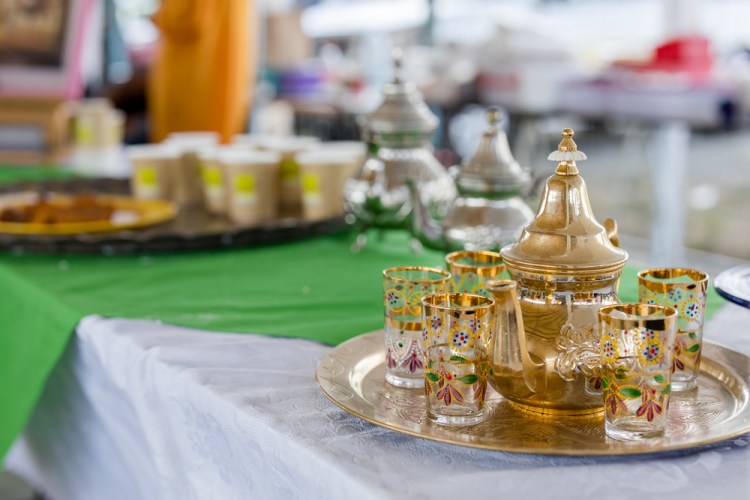
Everybody seemed to be there, really everybody. Including me! And this cute four-legged fellah:
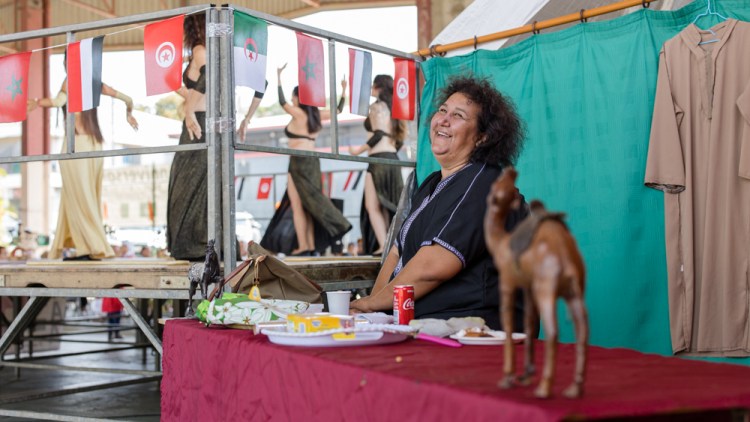
Nobody seemed to take any particular notice of me, so I had to take the initiative myself if I wanted something to happen. So I approached Véro, a wonderful lady who not only gave me free coffee but also answered all my questions.
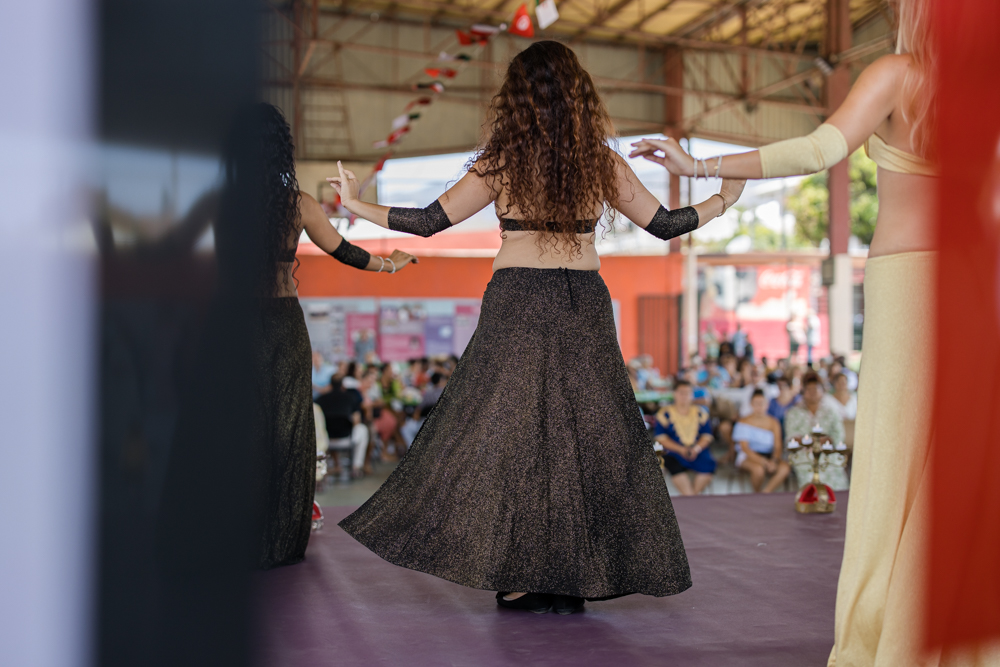
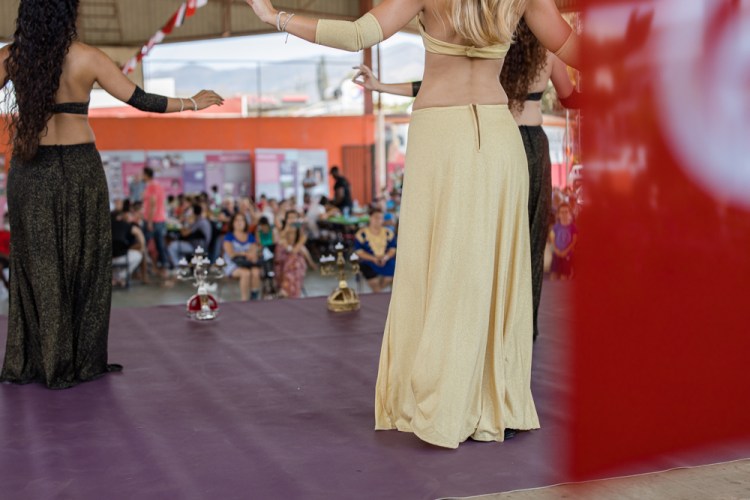
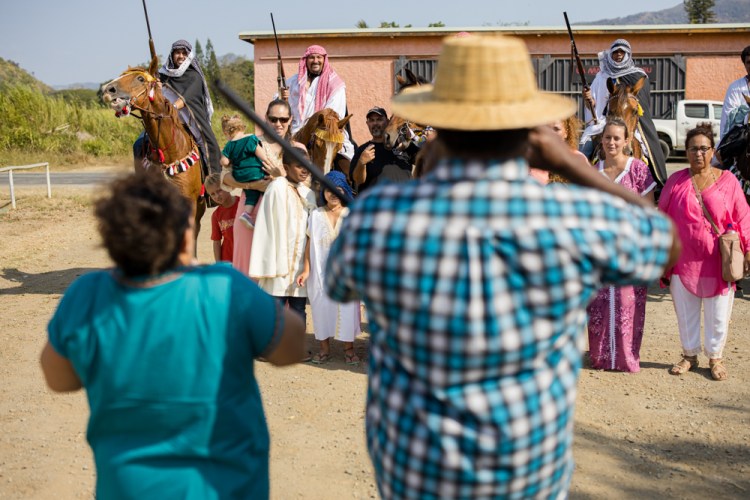
And then the “groupe de danse”. Never in my wildest dreams had I imagined to witness a formidable bellydance performance by an ensemble of eight young ladies, one more beautiful than the other, complete with colourful costumes, chandeliers, golden crowns, sabres and what not. This may have easily been already the highlight of my entire trip…
Do you share my enthusiasm?
But the final blow was yet to come. On the affiche it had said that the programme was to be closed by a “FANTAZIA” (in capital letters). I had no clue what this was, so I asked Véro, my personal guide. She explained that it is a performance by men on horseback, and they shoot in the air more than once. It is usually reserved for special occasions such as weddings. But what is the 50th anniversary of AAAA, if not a very special occasion!
When Véro saw the worried look on my face (right after she had mentioned the shooting in the air), she quickly appeased me by adding that, this time, there would be no bullets in the rifles. Ah! Thank you, good to know.
I must say, the show was brilliant. I couldn’t believe my luck (and I still can’t). Everybody seemed to enjoy the show immensely. Thousands of pictures were taken, not counting the 1,119 images on my SD card alone!
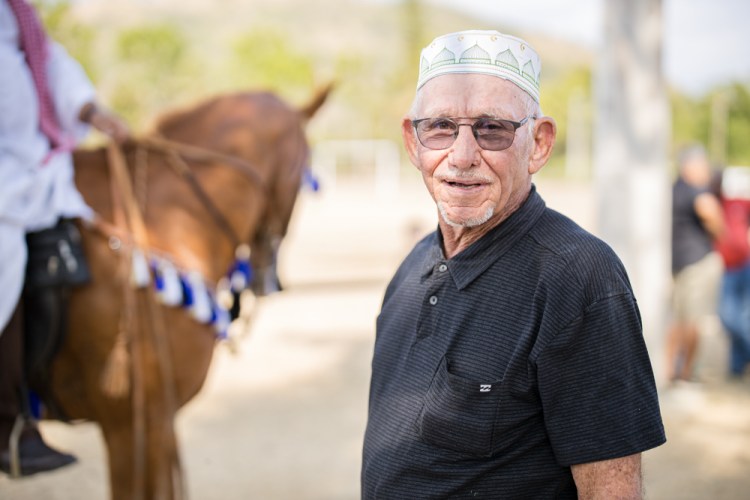
This is Kader. He is former president of the AAAA and the person at the very centre of all things Arabian in New Caledonia. Véro introduced me to him, and we exchanged phone numbers. I am hoping to meet him again next week for an in-depth interview and some more photos. He is one of the few New Caledonian Arabs who has actually been to the Maghreb, when many years ago an official delegation visited Algeria, the land of their ancestors.
Kader asked me to take a picture of him together with his cousin. No need to ask me twice for sure. I wonder why they are having such an earnest expression on their faces. Well, I don’t know if that is the reason, but if you look at their family histories and the fact that their Arabian identity was totally suppressed until the late 1960s, you get an idea why. But things have definitely changed for the better, as everybody assured me.
Another scene I found rather touching was when, at the end of the fête, Arabs and Melanesians did the “coutume” together. It is a very traditional practice and one of the pillars of Melanesian (Kanak) culture. Presents are exchanged (usually pieces of cloth, tobacco or cigarettes, and a small amount of money – you can see them lying on the ground in the middle), and words of gratitude and appreciation are expressed by senior members of the group. All this is done in a very quiet, focussed and solemn mood.
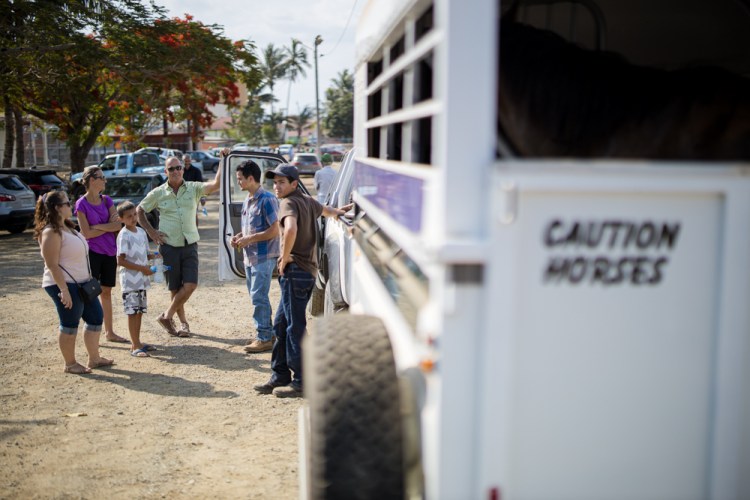
Not only did I get an intriguing insight into the Arabian community yesterday, but also into the “Far West” mentality in this part of Grande Terre and into the “broussard” way of life. One of the symbols of it obviously being a decent pickup truck. And some horses, of course. And not to forget, cowboy boots!
What an amazing afternoon this was. I look forward to its continuation next week!
Do you want to see all the articles on New Caledonia? Then please click here.
After a week in the hills of Sarraméa and Farino, I felt like going to the seaside. So I packed my bags and drove northward along the west coast of Grande Terre. I am at Poé plage now, which belongs to the little town of Bourail. It is still part of the Southern Province of New Caledonia.
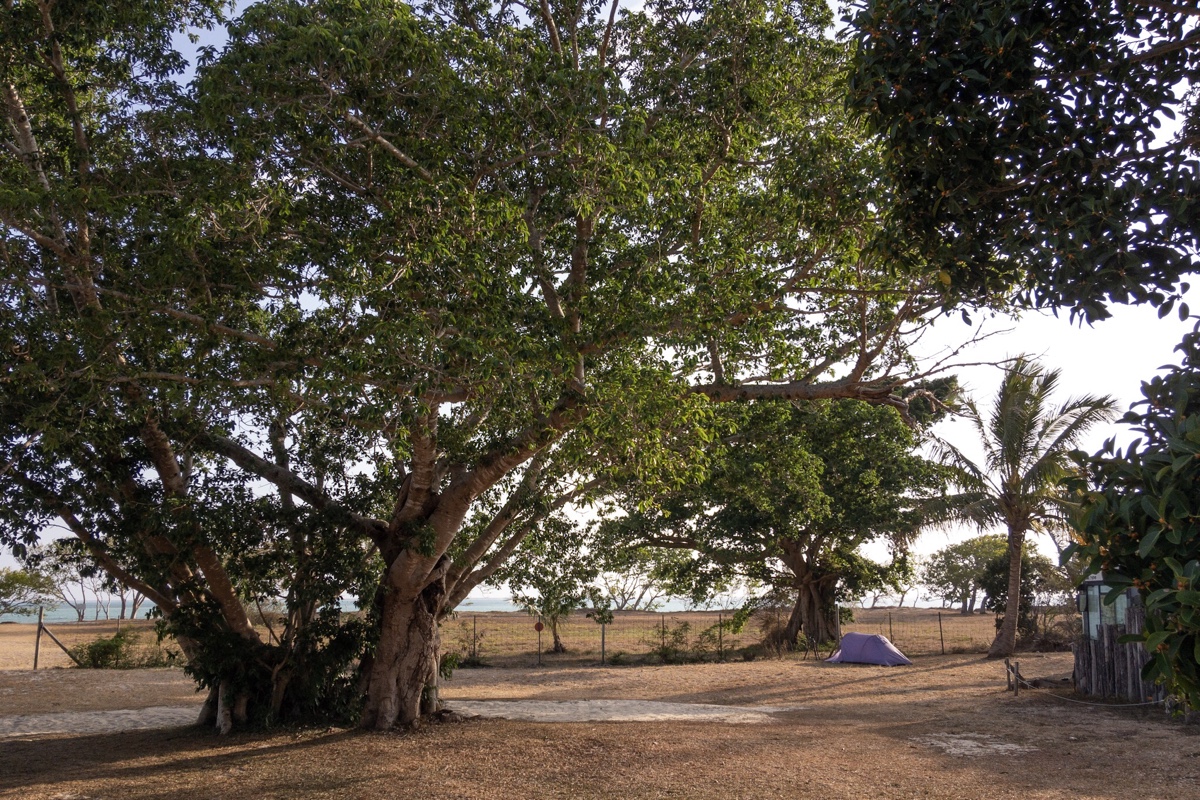
Can you spot my tent in the photo? It would be a bit more difficult now to see me, because in the meantime a number of other campers have arrived and put up their tents.
The most important thing in this picture, however, (and about this place in general) is the sea anyway!
So I am spending the weekend at “Le rêve de Némo” (Nemo’s dream), the meaning of which somehow escapes me. It is a nice place in a nice location, but perhaps not in a super-duper breathtaking way. Relaxed, yes, which is good, but maybe not something you’d travel around the world for. And I want super-duper, I demand nothing short of perfection!
So I guess I’ll move on today and drive across Grande Terre over to the northeastern side. I’ve been recommended the little town of Hienghène and its surroundings, so that is where I’ll go today.
By the way, I not only took photos with my phone here (such as the ones in this post), but also with a decent camera. I’m hoping to share them later today or maybe tomorrow.
And then I also want to relate the most incredible event I attended in Bourail yesterday. But let’s keep that a secret just a little longer, shall we…?
It was a privilege and an honour to get to know Ariane over the past few days. And now, equally, it is my pleasure to introduce her to you, my global audience.
But who is she?
Well, Ariane works at Refuge de Farino, where I spent the last five days, and this is how we met. She is the “femme de ménage”, which is without doubt the most important job on the compound. She has been doing this work for sixteen years now.
Every time we met, we would smile at each other (it’s hard not to smile back at such a face, I tell you) and exchange a few words in French. Because my knowledge of this beautiful language is rather limited, so were our conversations. But nonetheless, it was always a pleasure to talk to her.
Today, on the day of my departure from Farino, I took all my courage and asked if I might take some photos of her and ask her a few questions. Needless to say, she said yes without hesitation.
I have to admit I was a bit nervous, but that went away very quickly. I think she was a bit surprised but also a little bit flattered that I wanted to write an article about her. I know she is going to read it, because I gave her the URL of this blog.
(Salut, Ariane! Ça va?)
Ariane told me that she was born in nearby La Foa and has lived in this region ever since. She now lives with the Kanak tribe (tribu) of Grand Couli. They are one of three tribes in the village of Sarraméa, the other two being Petit Couli and the Sarraméa tribe. When I asked whether she could ever imagine to live elsewhere, perhaps in a city, the reply was a very clear NO. At home she speaks the local Melanesian language, but she has also always known French as a second language. It can be very practical to know both languages – sometimes maybe you don’t want to be understood, so you just switch from French to your mother tongue…
You may have heard about the discussion in this country (sometimes an open conflict even) about a possible complete separation from France, and about Nouvelle-Calédonie becoming the independent state of Kanaky as a result. Ariane said she was in favour of such an independence, but that such a new state should be a home for all kinds of people, regardless of their ethnicity, origin or skin colour. She also made it clear (that was actually after the end of our little interview) that there is everyday racism in New Caledonia. She mentioned several cases in which people of colour were discriminated against because of their ‘race’, for instance on the labour market. When I asked if things were improving in this regard, she said she didn’t think so. It may not be as bad as in Australia with the marginalisation of the Aboriginal people, but that is rather cold comfort and not much solace.
Here she is, mother of four children, three of whom are already in their late twenties, plus one latecomer who is ten years old (le petit) and goes to primary school in La Foa.
When we parted, we both agreed that we have to meet again one day. In the meantime, I wish her and her family all the best. Merci pour l’entretien. Ta-ta!
PS: I have added a new category to this blog, “meet the locals”. There are two entries in it so far, “Alice” and now “Ariane”. To be continued!
Do you want to see all the articles on New Caledonia? Then please click here.
You will now learn how I spent the first 48 hours on Grande Terre, New Caledonia’s main island.
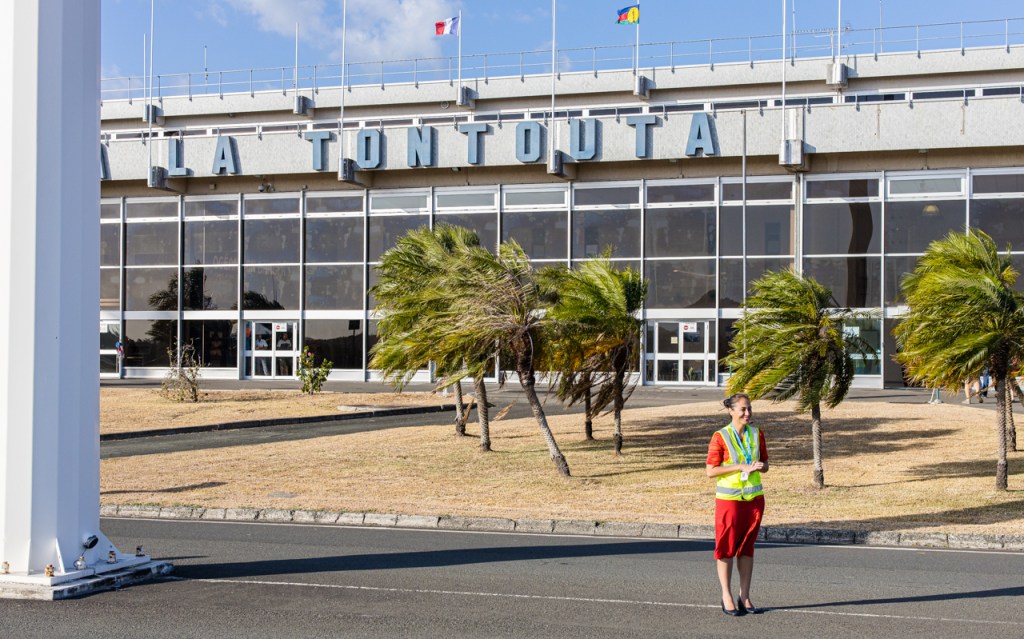
At La Tontouta airport I tried in vain to buy a SIM card. It was a few minutes past 5 pm on a Friday – week-end! Almost everything was closed, even the restrooms. Fortunately not the car rental office, though, where a friendly young lady with pink finger nails handed me the keys to my car (you’ve seen it already here, no need to show it again). What next?
I was a man with a plan. I would not drive south towards Nouméa, the main city of New Caledonia, but instead in the opposite direction. Because I had an appointment the next day! And here’s what I really want to tell you about: the great time I had with the Société Calédonienne d’Ornithologie (SCO) right after my arrival on NC.
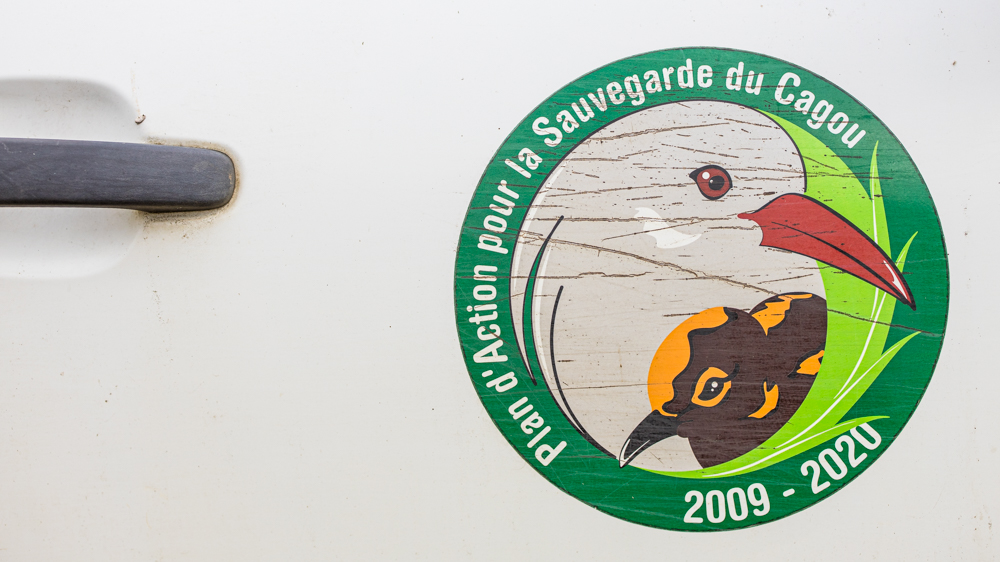
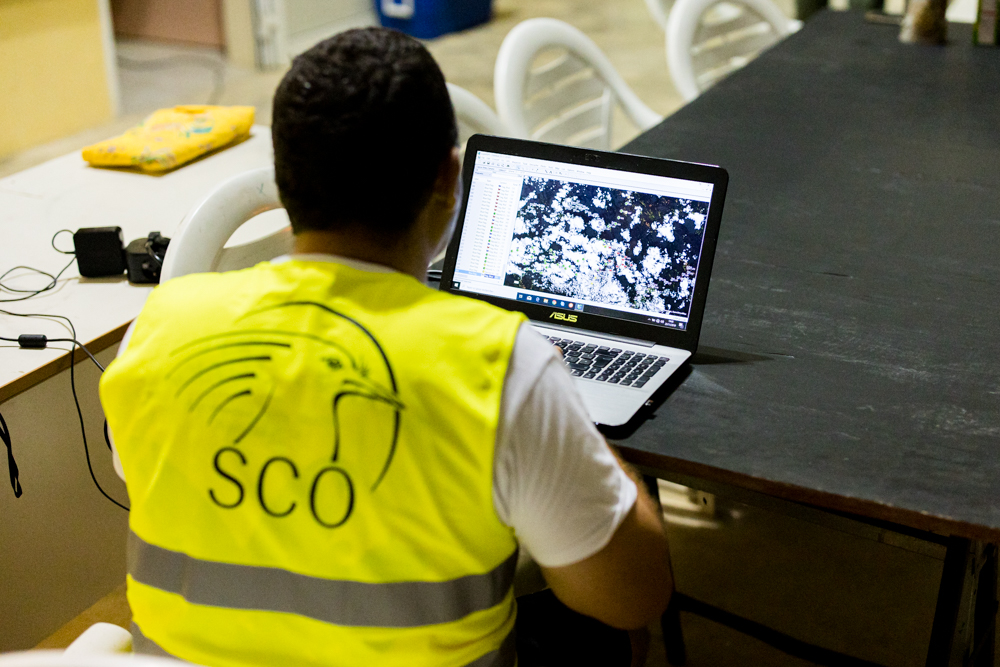
I had contacted the SCO some time before my departure from Germany in order to enquire whether they had any interesting activities I might take part in. By the way, they have an informative website as well as a Facebook page with tons of great photos of New Caledonian birds. In reply to my enquiry, David, the president of the SCO, had told me that at present they do not have any larger projects I could join. However, there would be a week-end activity on November 23 and 24. Volunteers would meet, camp together, and then very early on Sunday morning they would organise an „écoute matinale“ of New Caledonia’s emblematic bird, the mysterious Kagou. All this would take place in and around the village of Sarraméa.
Funnily, this was the area I wanted to start with anyway! From my first visit five years ago I remembered very well the magnificent Parc des Grandes Fougères (more about that in another post) as well as the nice Refuge de Farino nearby with its bungalows and attached little campsite. So I headed north for Sarraméa.
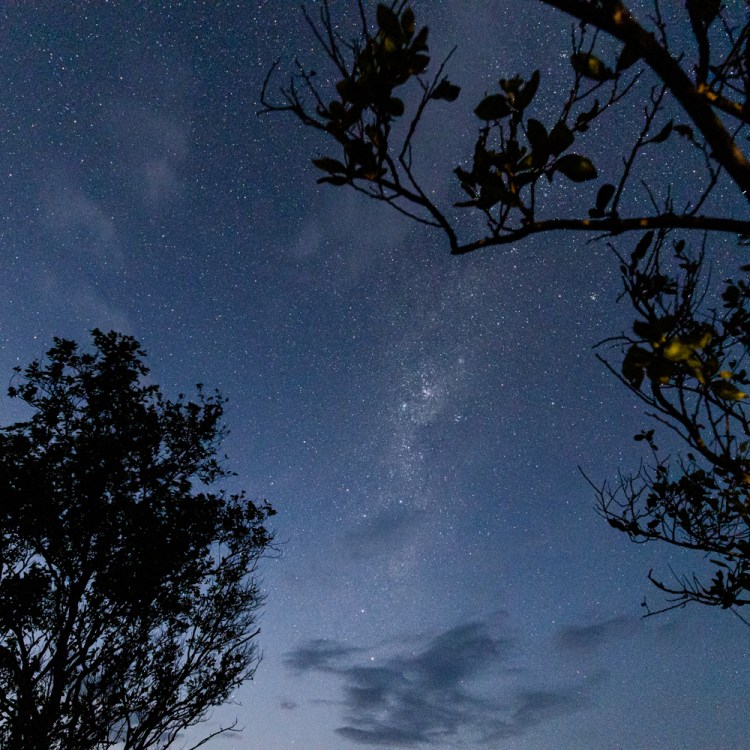
The first night was uneventful. I simply put up my tent in a suitable place (the market place, as it later turned out). I was treated to an amazing star-filled sky at night – without the orange light of the street lamp this picture would look even better, trust me.
The next day was sunny and warm, so I went birdwatching. This beauty here is a white-breasted woodswallow (Artamus leucorynchus).
Then came the afternoon and the meeting with the SCO people. First impression: very friendly! David gave a short introduction on what we would do the next morning. We were enough people to form twelve teams of two people each. Every team would spend two hours at a specific spot and listen out for calling Kagous. The problem with this bird is: it may not be able to fly, but it is quite mobile and hides well in the forests of this rather hilly part of Grande Terre. Very little is known about its present population and distribution, so the SCO has a scheme for researching and monitoring this very rare bird species.
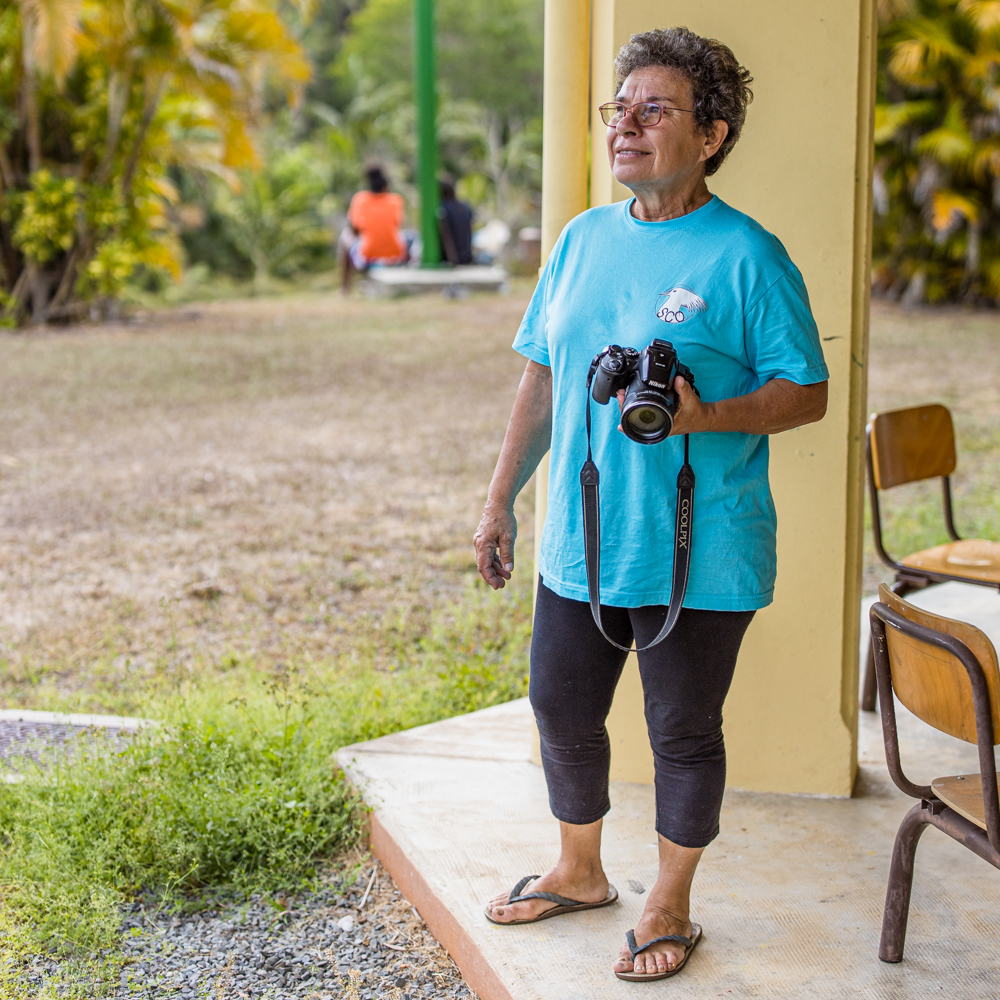
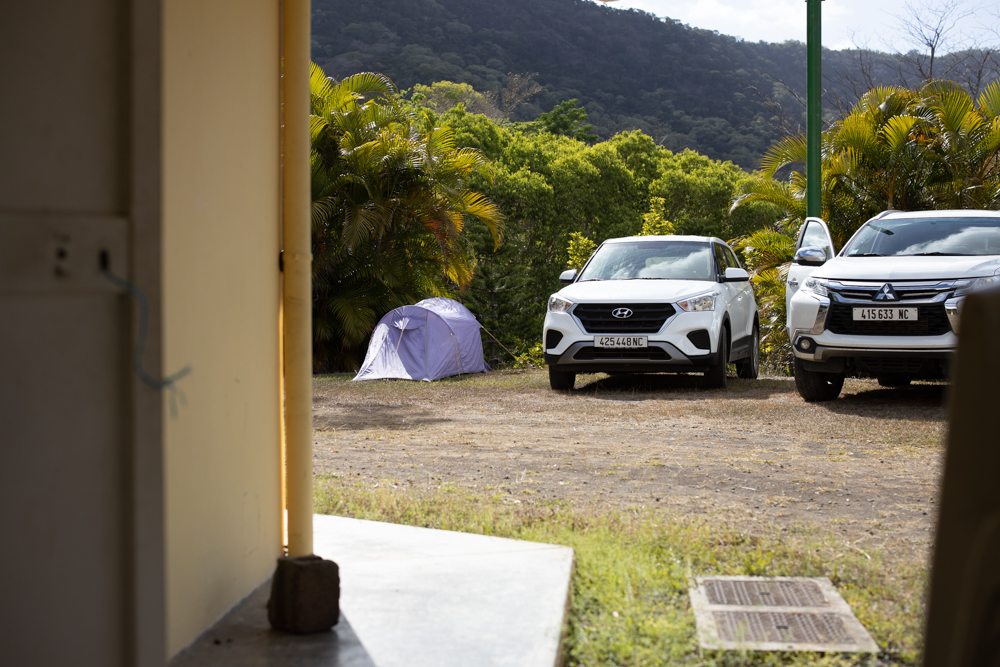
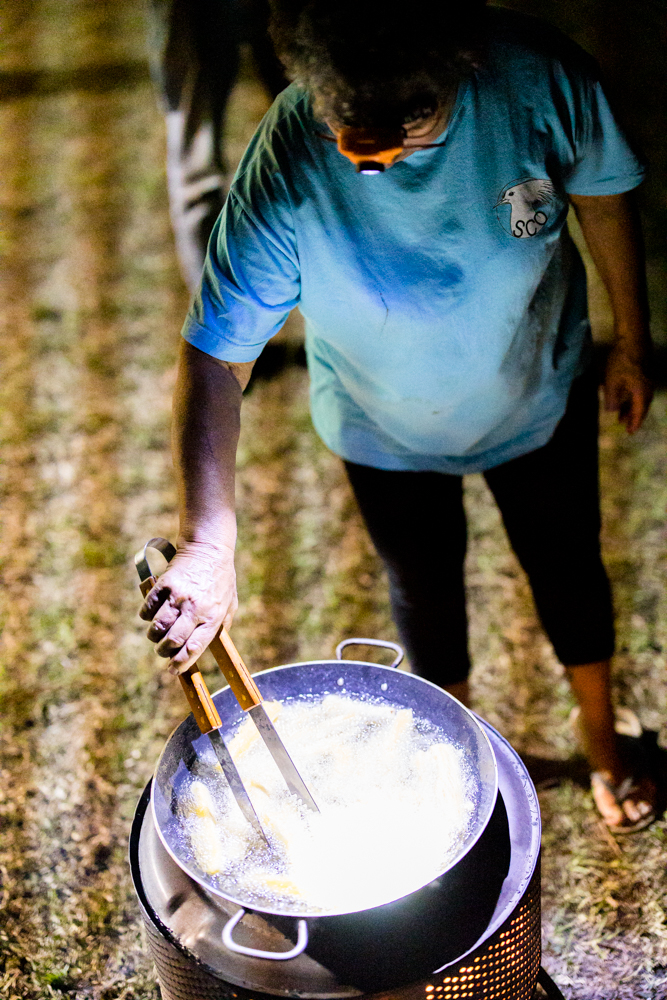
Liliane is the good soul of the SCO. And a keen photographer. And a great cook (see below).The litte purple thing is my tent. Don’t laugh, it’s really huge on the inside.
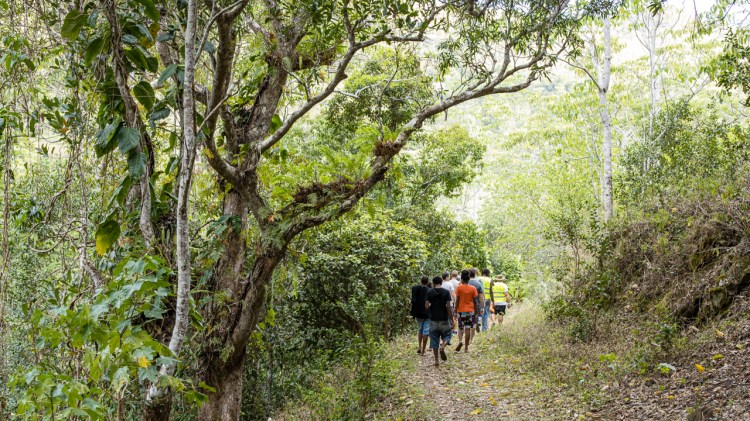
In the afternoon we visited one of the spots which would be occupied the next morning. The landscape there is just beautiful!
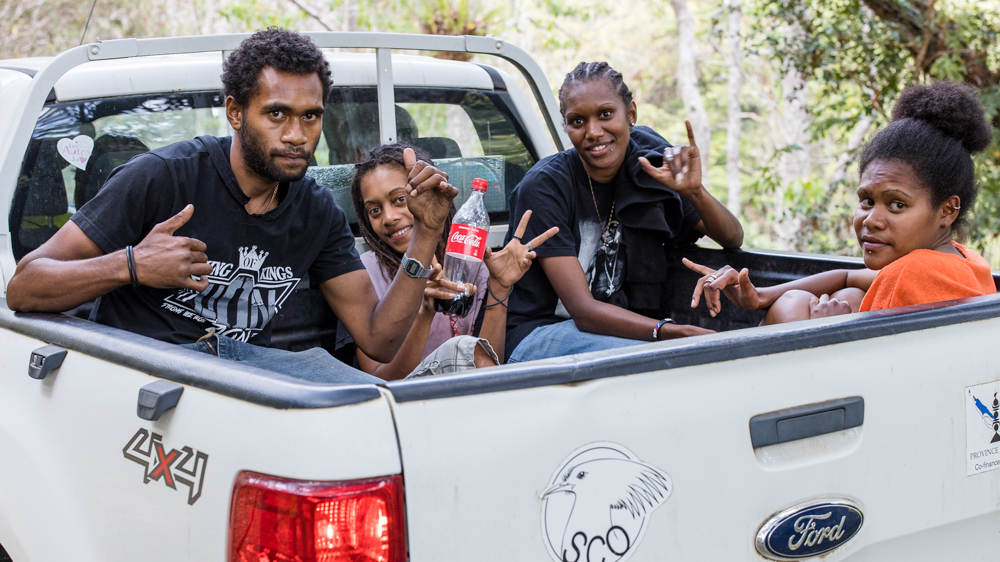
The kids got only in there for the photo, while the car was standing!
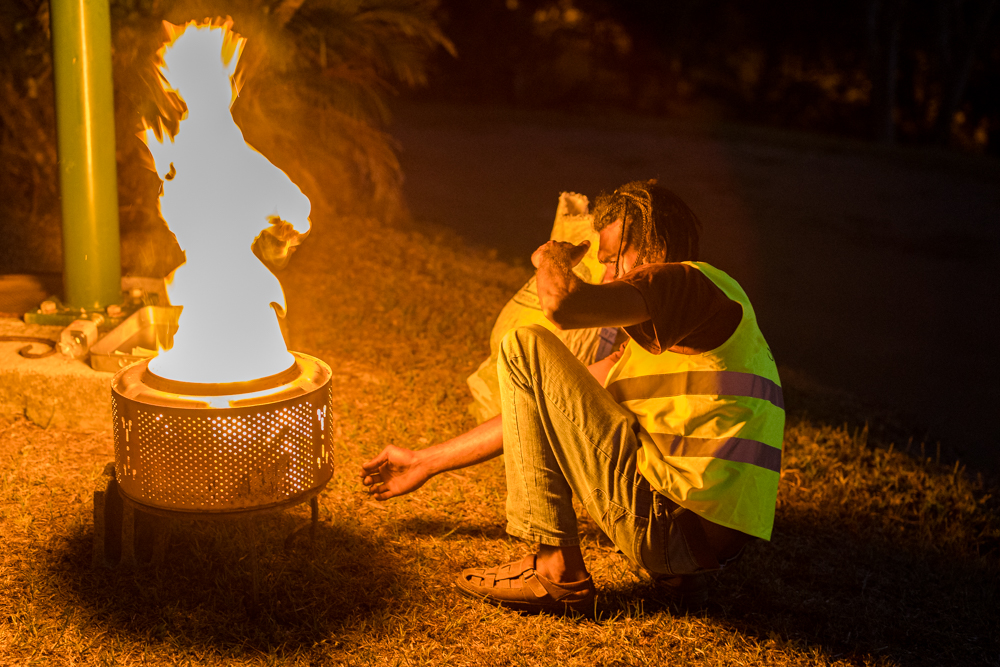
Then came the evening with a little barbecue and great food (merci, Liliane!), and people were handed their equipment for the „écoute matinale“. Very matinale indeed: We would have to get up at 3.30 am in order to be at the designated spot in time for the session to begin at 4.00 am, exactly one hour before sunrise…
David and I formed a team, for which I was really grateful. And what a fantastic morning it was! Really a breathtaking experience. And that is despite the fact that we did not get to hear any Kagous. But I wouldn’t want to miss a single second of this unforgettable morning, complete with starry sky fading away in the beginning of the day, a large flying-fox gliding past, and an amazing dawn chorus of what seemed like hundreds of birds singing to their (and my) heart’s content.
Back at the base camp in Sarraméa, people gathered, cold, tired and hungry. But satisfied! All in all, five out of twelve teams had heard Kagou calling. Quite a success.
Then some of us went for a little post-event excursion to a botanical sensation: Amborella trichopoda, the world’s oldest flowering plant species. Interesting? Yes. Fascinating? Errrm, maybe. Attractive? Definitely not. I will never become a botanist, that’s for sure…
All in all, a perfect start to my stay here in New Caledonia. And I am sure I will meet some of the SCO people again when I’m in Nouméa, and perhaps we will go on another excursion together. I’m open to anything and look forward to it already!
A have a confession to make. But please promise not to tell anyone. It is something I experienced in Sydney, and I have to say, I really miss it already over here in New Caledonia.
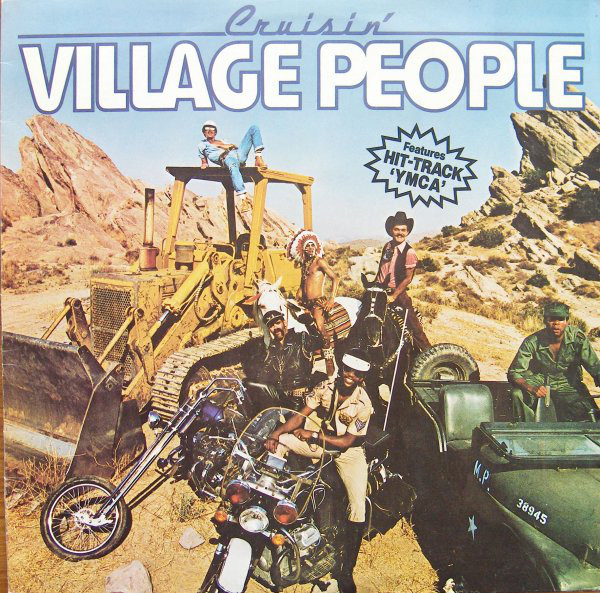
You all remember Village People, the band, right? I guess everyone can sing or hum along to ‘YMCA’, even if they don’t know the lyrics or don’t catch their deeper meanings. Believe it or not, but their 1977 debut album was the first record that I owned! (yes, that’s right, it was a vinyl LP). I was five at the time and did not fully grasp what was meant by the phrase ‘you can hang out with other boys’. My ignorance didn’t matter then, and neither does it now.
You are wondering where the hell this is going, don’t you? Well, just wait.
I could look at that record sleeve for hours on end, and I really admired all those handsome guys in their costumes (did I ever think they were real?). My favourite personas were the cowboy and the ‘red indian’. And I thought the police motorcycle was really cool. I barely noticed the construction guy on his caterpillar, though.
And now this:
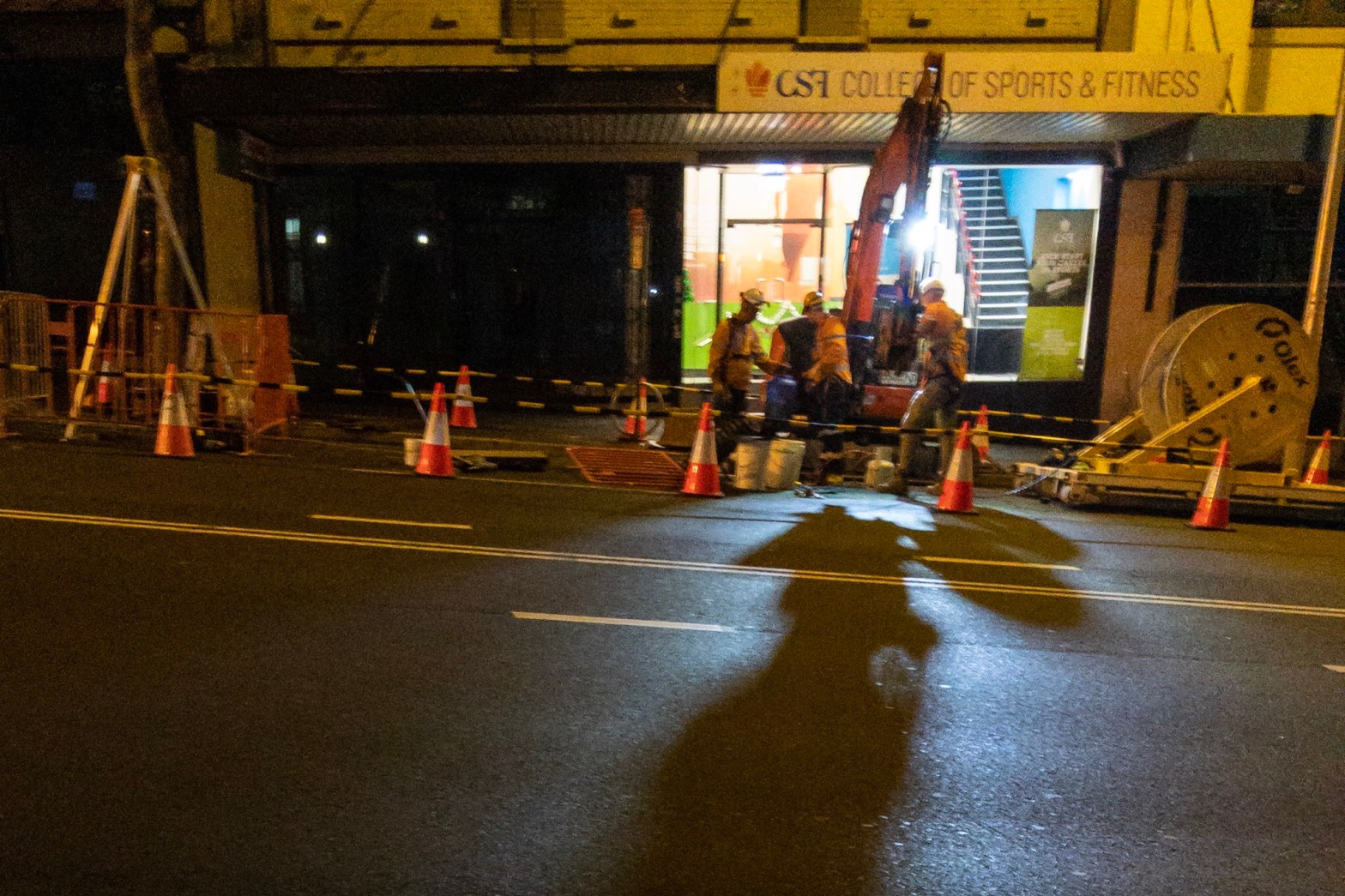
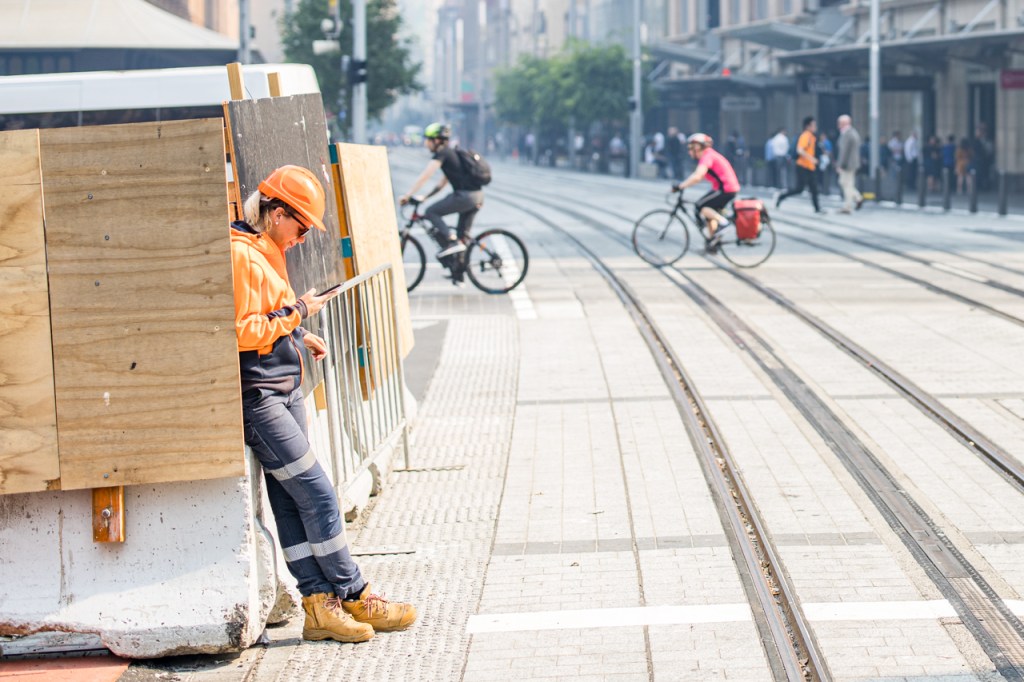
I have to confess that I have a major crush on all those road construction workers and traffic controllers in Sydney. They are SO COOL! And I don’t give a flying flamingo whether they are male or female or diverse or what not. With their hard hats and their reflective vests and those huge safety boots – they are just so much pleasure to look at! (But not too close and obvious, though, because I must say I am also rather intimidated by them.)
And let me make one thing absolutely clear: this is not about me being attracted by uniforms. Firstly, because I’m not, and secondly, because I don’t see their work clothes as uniforms.
See what I mean?!?
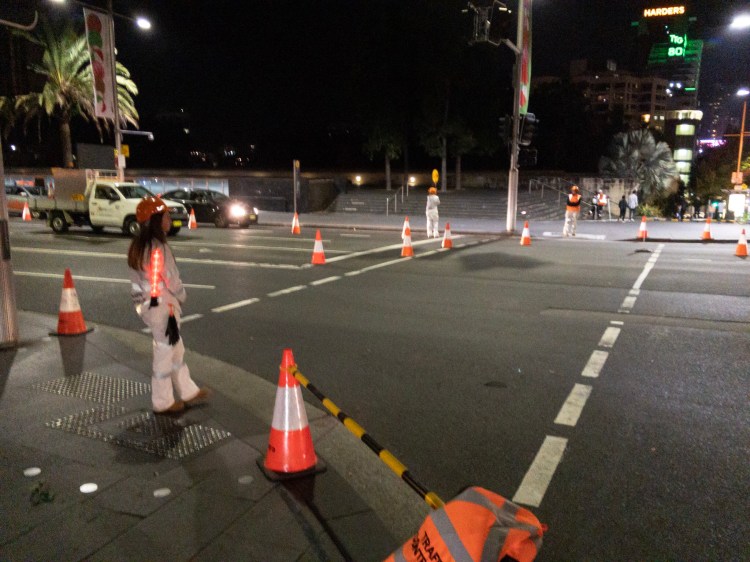
There was one particular incident which tells you everything. It was evening and already dark on my first day in Sydney when I walked back from Mrs Macquarie’s Chair (where I took pictures of the Usual Suspects) to my hostel near Central. There were lots of road works going on and traffic had to be controlled. There was this huge road junction that I needed to get across. The traffic lights had been switched off, and there were these four young women, one in each corner of the crossing. I had to wait really long, because cars always go first in Sydney. I was standing behind her. And whenever she made a sign that another line of cars could drive past now, I made the tiniest of movements because I had hoped it would be my turn at last. And she would gnarl, without even looking at me: ‘Not you!’
Wow! Needless to say, I did not dare to ask if I could take a proper picture of her…
This whole thing is something that struck me as odd. In Germany, you hardly ever see women around construction sites or road works. Everything seems to be carried out by men. In Sydney, however, you see both women and men. Maybe the men are doing most of the actual construction work while the women mainly control the traffic, I don’t know.
Whatever the explanation might be, these folks are definitely a sight worth seeing! (And you don’t get them in New Caledonia, sniff…)
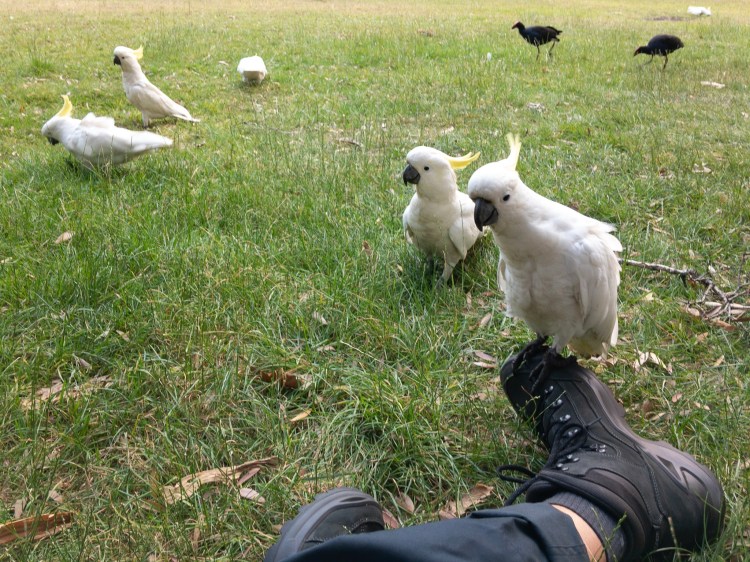
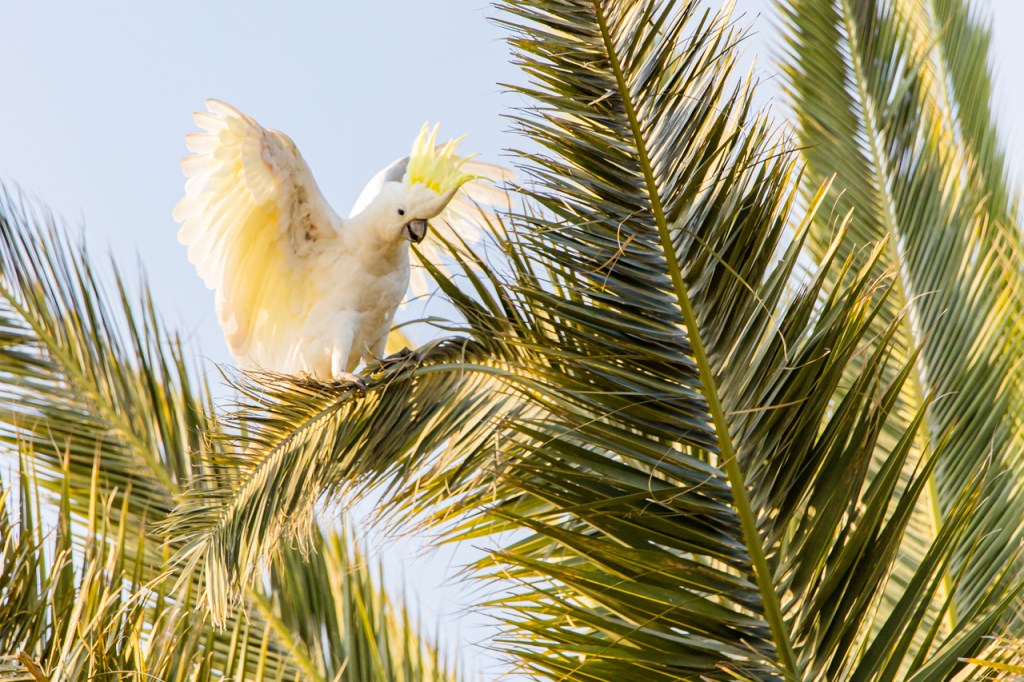
Taking a picture of a sitting cockatoo is one thing. Not difficult – sitting duck, so to speak. Especially if they are so kind to approach you, well, almost too near!
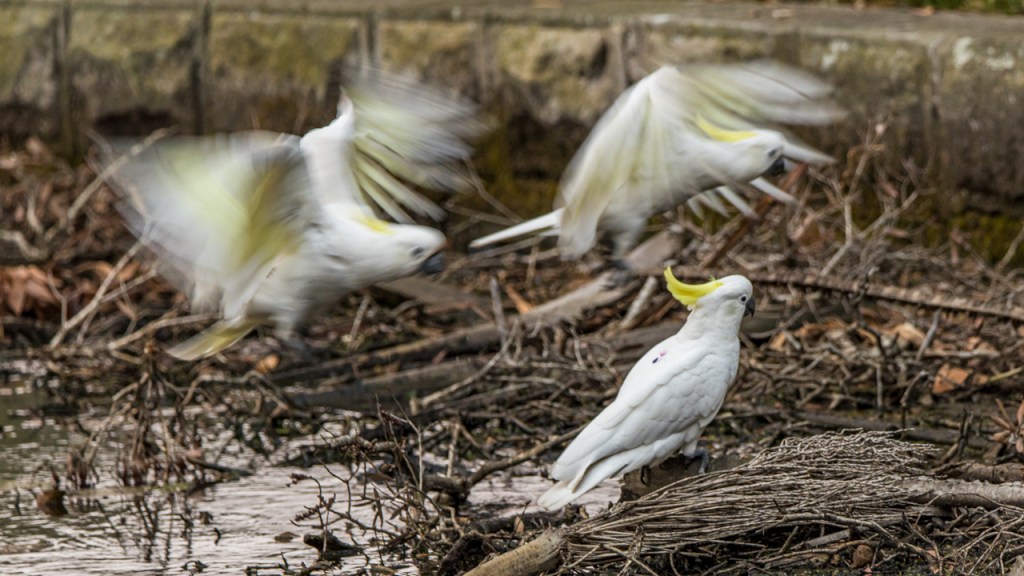
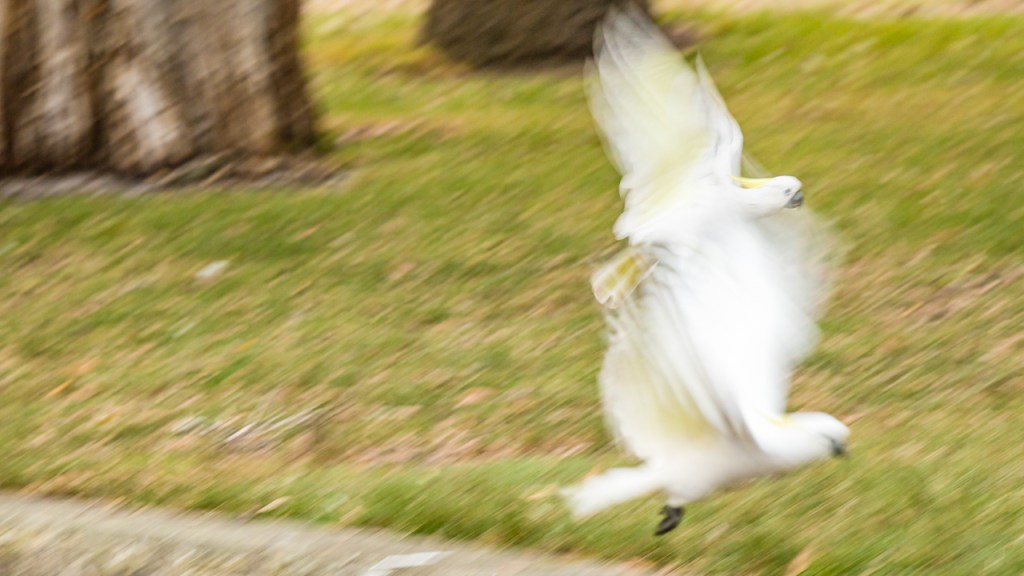
A different thing, however, is taking an ‚action shot‘ of these magnificent birds in flight. Photographing flying birds is probably the Champions League of wildlife photography – which is precisely why I won’t even try 😉
Oops, broke my own rule here… And you see exactly what happened.
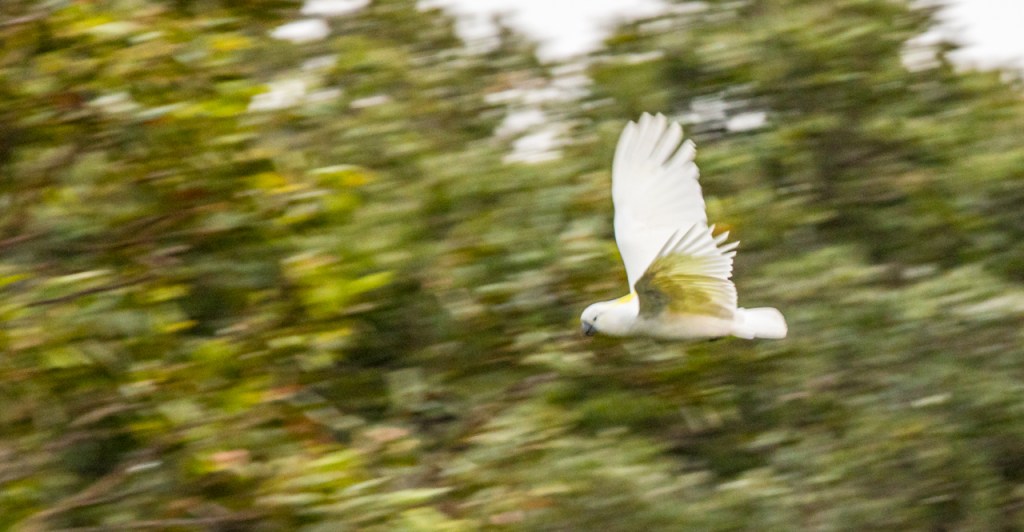
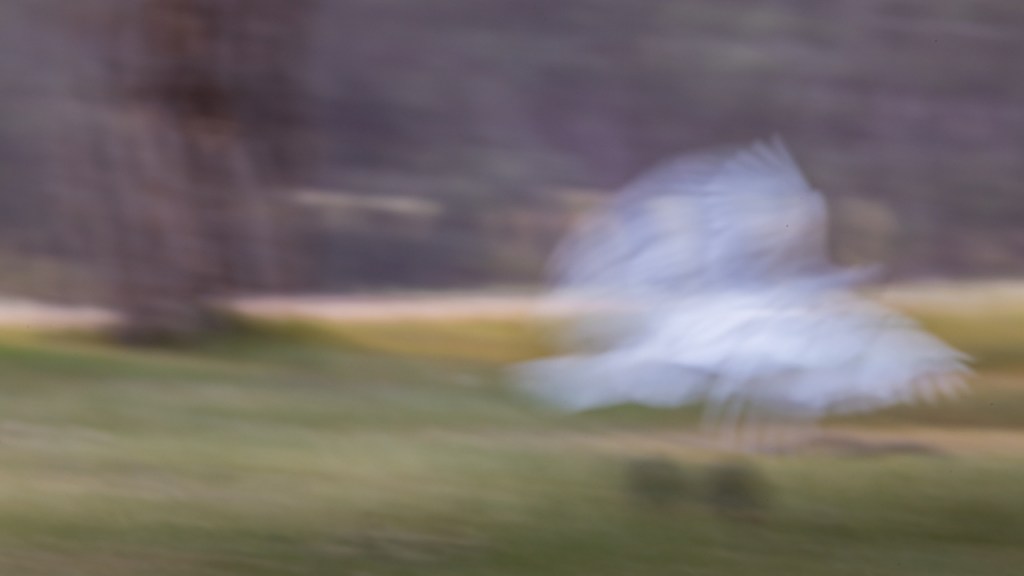
That said, when I went to Sydney’s Bicentennial Park (or, Olympic Park) the other day, I did have a certain idea for a photo series in mind. And it would involve flying birds. However, not in the classic style, but more, ummm, ‚creative‘ (and easier to achieve, hopefully!).
Finding the cockatoos wasn’t difficult, as I already explained. The are loud, bold, and constantly on the move, be it on foot or on wing.
Furthermore, they are kind enough to be largely white, which makes it easier to spot them and to follow them around, when they fly. The autofocus in the camera is also rather grateful.
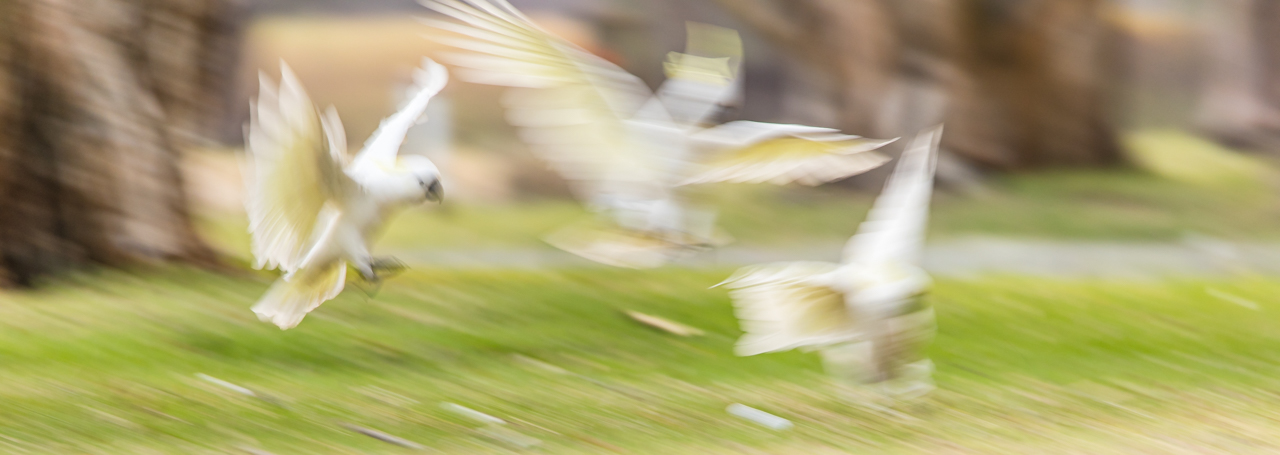
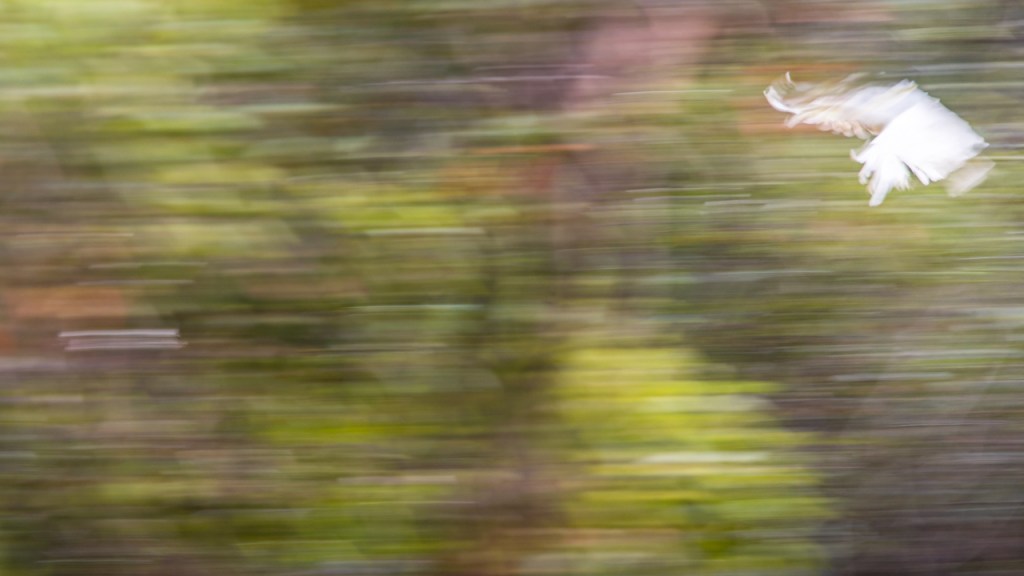
The rest just happens automatically, really: the light fades as dusk approaches, you cannot possibly push the ISO settings any further, the shutter speed gets slower and slower…
Sharpness of images is a thing of the past now. But hey, who cares?
The bird ghosts of Centennial Park – it was a pleasure to spend some time amongst them.
WARNING: The following post is not quite up to date, as it contains material that I have gathered last week in Sydney, i.e. not New Caledonia. Furthermore, it should only be viewed by people who are not bored to death after five wildlife-related pictures. So don’t complain afterwards, do you hear me? You have been warned!
One of the things I had been really looking forward to in Sydney was to observe the parrots in the city parks – and hopefully to capture them with my camera. I was not disappointed! However, even though they are generally widespread and also quite conspicuous (loud!), I didn’t find it that easy to actually find and photograph them.
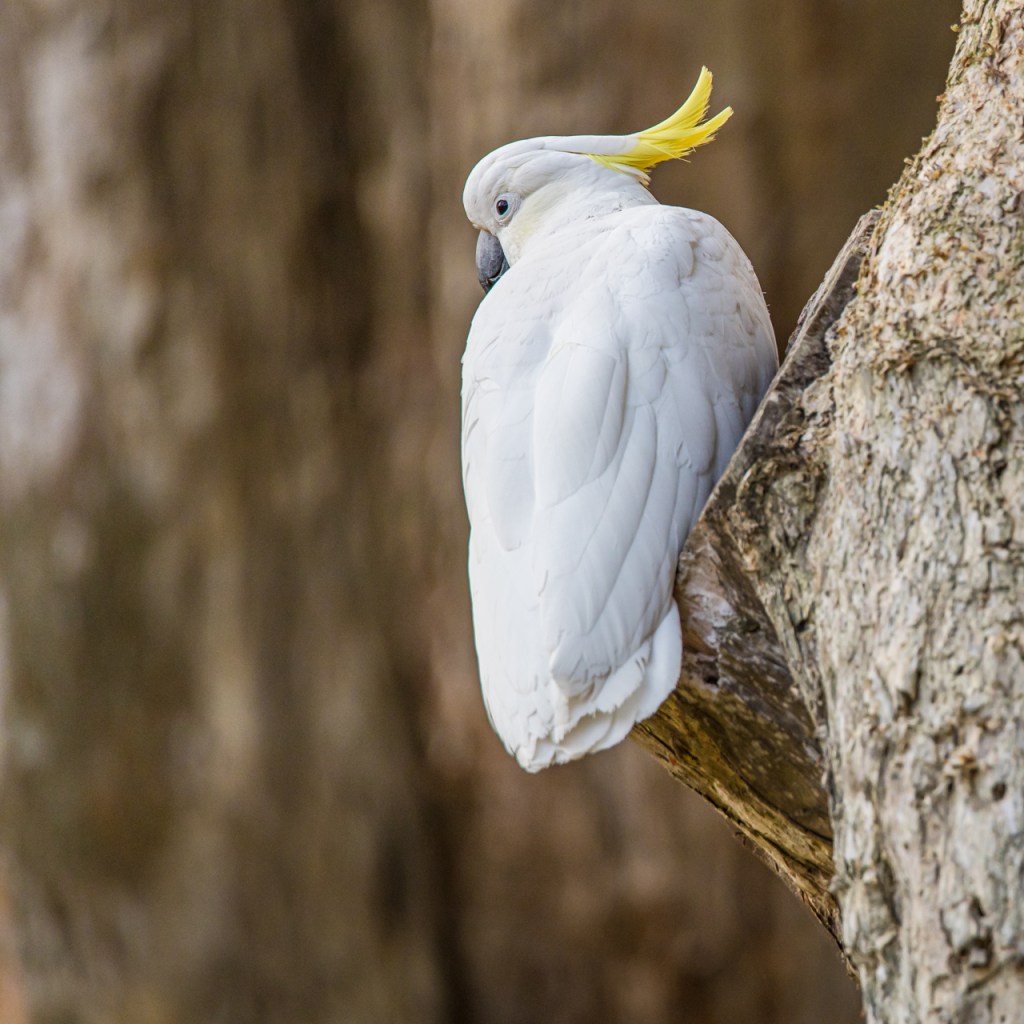
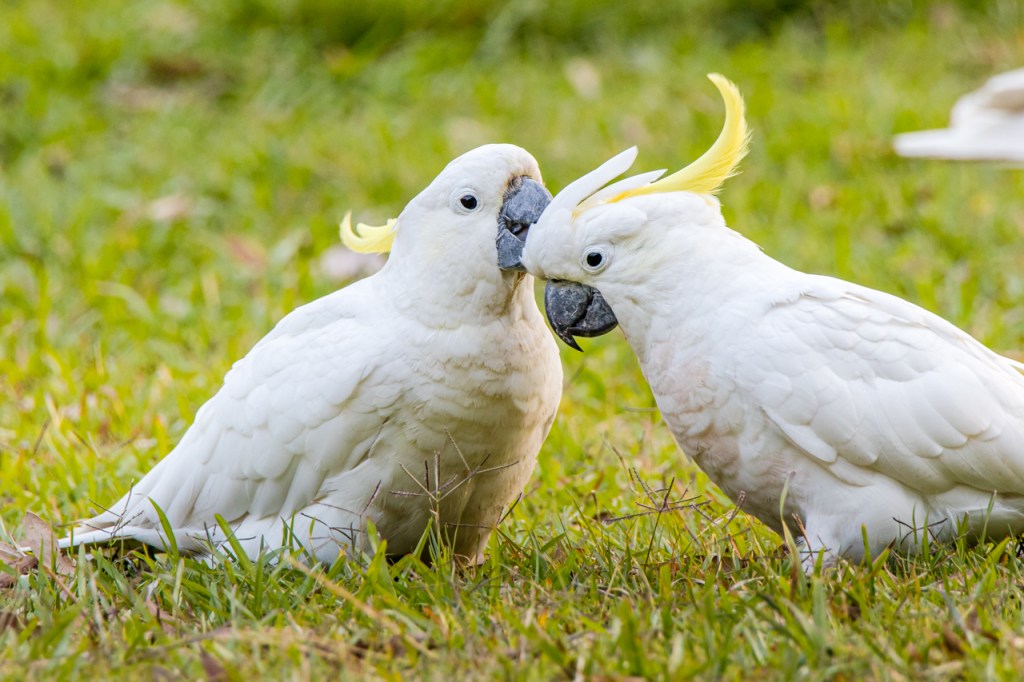
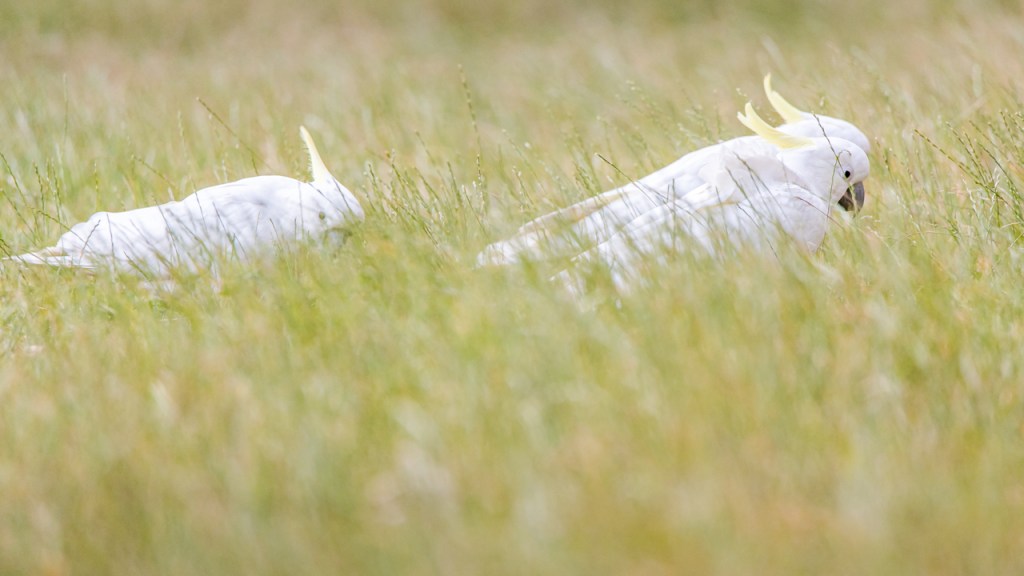
As far as I know, there are basically three common species of parrots to be found in Sydney. One of them is the sulphur-crested cockatoo (Cacatua galerita), which is really massive and very loud, and not shy at all!
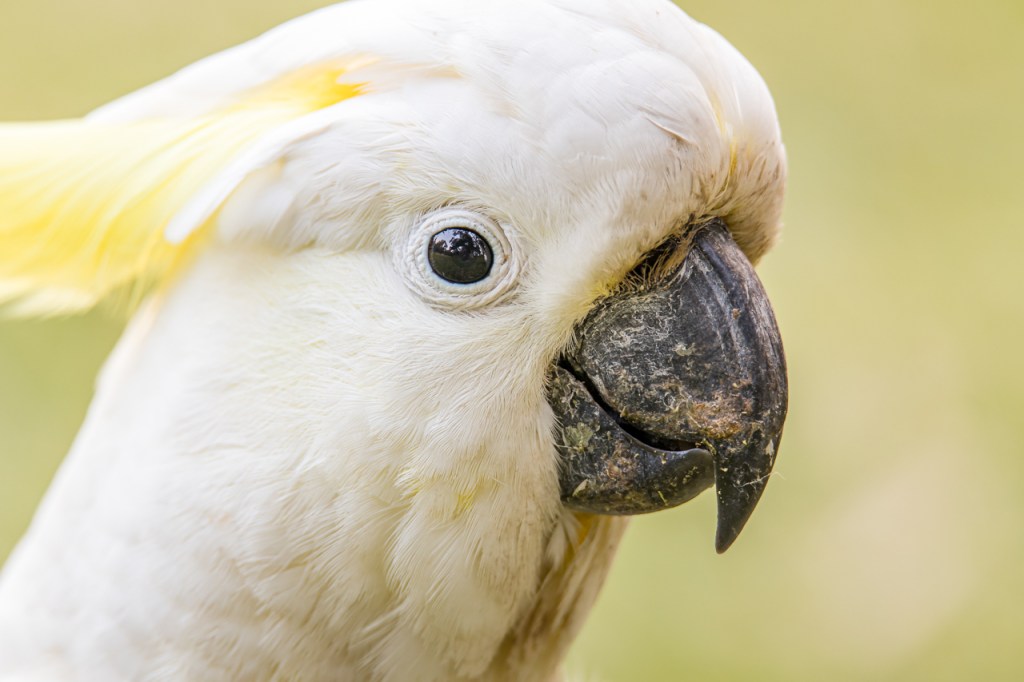
Wikipedia will tell you the following: ‘A highly intelligent bird, they are well known in aviculture, although they can be demanding pets.’ Now that’s one thing I can believe. They definitely look like trouble!
But aren’t they also really cute? I never saw them alone, always in company.
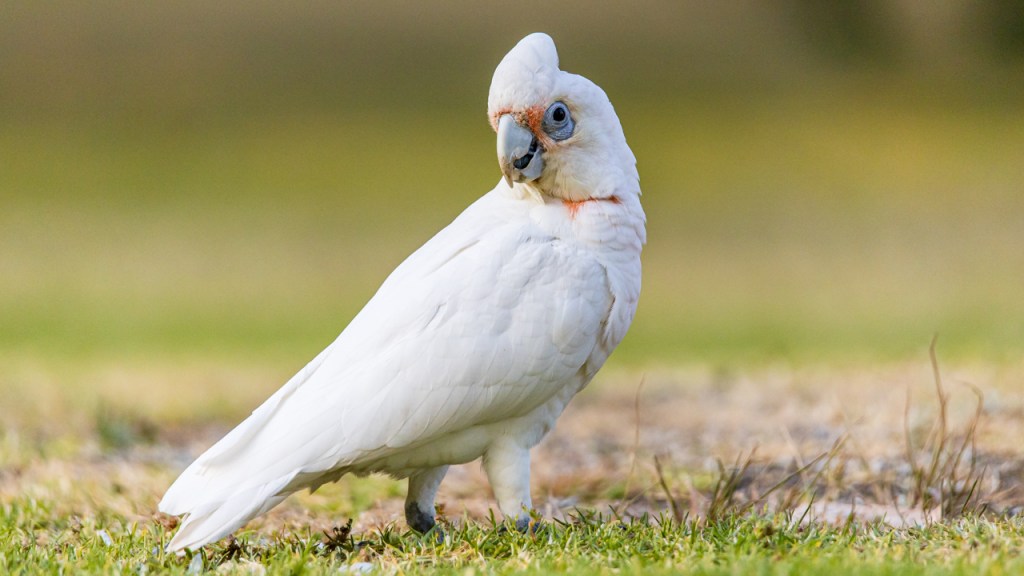
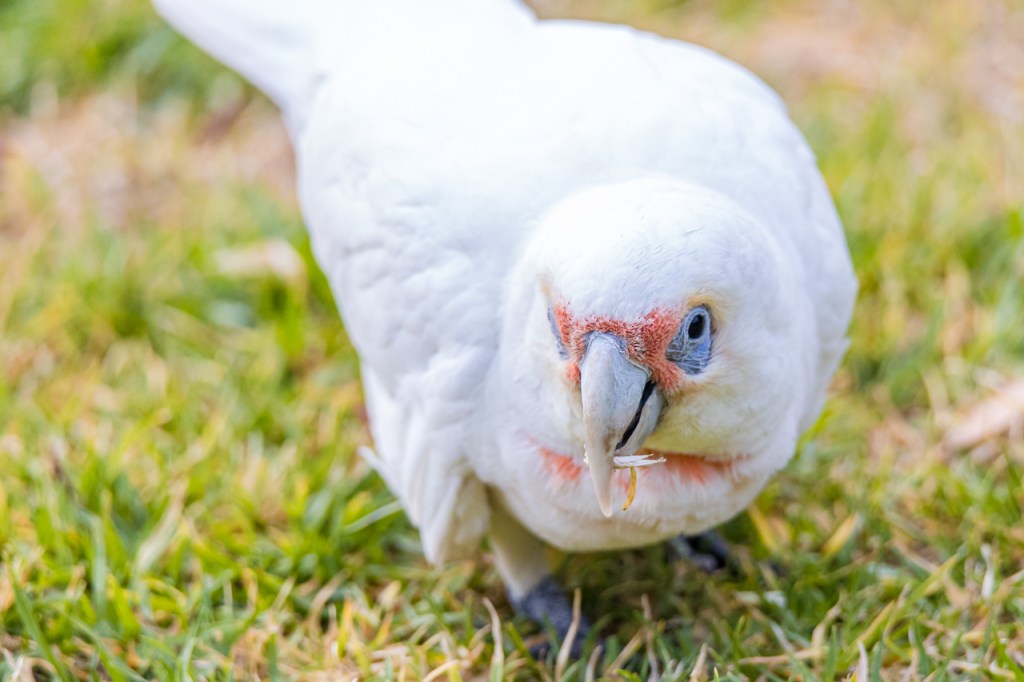
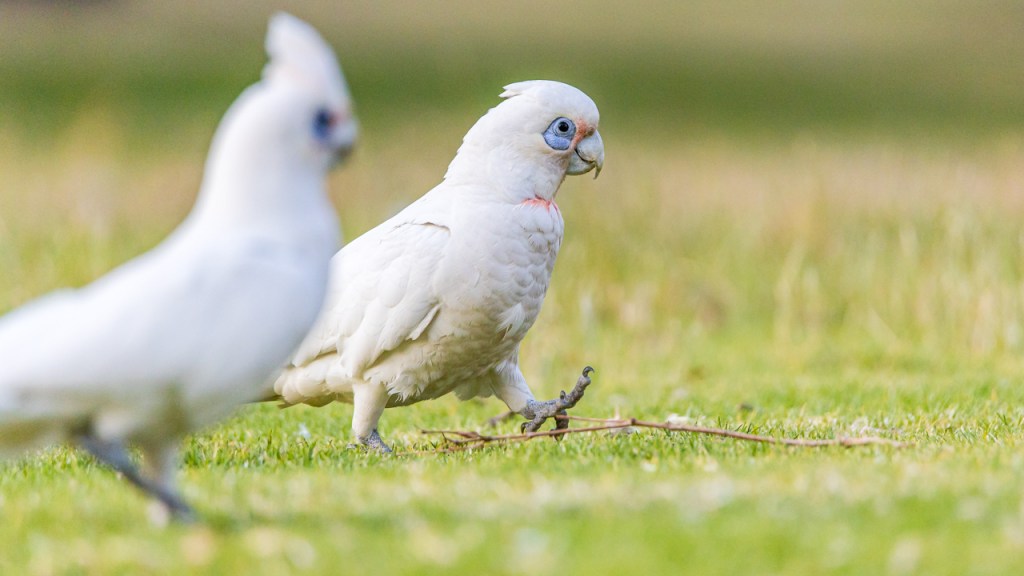
Another parrot species is the little corella (Cacatua sanguinea), a lot smaller than the first cockatoo, and also with a generally more modest appearance, if you know what I mean.
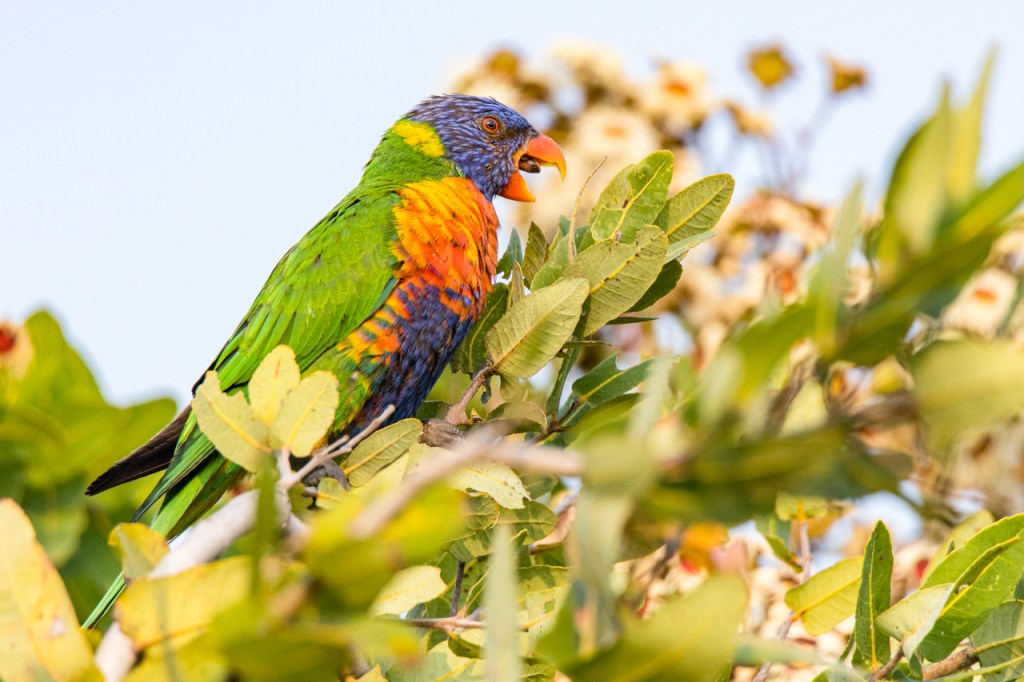
The third one, and in fact the only true parrot of these, is the rainbow lorikeet (Trichoglossus moluccanus). I find it incredibly beautiful!
Unfortunately, I saw them mostly flying overhead at high speed, and only on two occasions actually sitting in a tree not too high above the ground.
Can you understand why I am so fond of these creatures?
Why on earth then did you travel to the other side of the planet, of all places? I hear you ask.
Well, I’m glad you asked that question. I admit that it is not entirely without justification, and I have had some time to prepare my answer.
Just a random set of trees at Parc des Grandes Fougères
Let me start off by telling you that this is already my second visit to New Caledonia, or Kanaky, as the local Melanesians prefer to call it. Five and a half years ago, in June 2014, I had the opportunity to attend a training course in Nouméa, the capital of New Caledonia. The course aimed at youth workers and other people working in the field of youth exchanges and international co-operation. I remember to this day certain shortcomings of the programme itself, but the event as a whole was just wonderful. I met some great people, from the archipelago as well as from other European countries, I got an insight into the cultural diversity of NC (including a day and a half with a Kanak tribe at Port-Boquet), I had a great extra five days exploring Grande Terre (the main island) and its wildlife after the course. And all this made me want to come back one day!
And I did come back!
The official language of Nouvelle-Calédonie is French. Apart from that, a great variety of other languages is used as well, e.g. various forms of Kanak, but also languages which different immigrants from other parts of the world brought with them in the course of the past 150 years. No English is spoken in public, though, and that is another great plus from my point of view. I have been struggling for years now to reach a decent level with my knowledge of French, and I am much hoping that this trip will do the job!
Saturday evening: field excursion near Sarraméa with the Société Calédonienne d’Ornithologie (SCO) (more about them later)
As I am writing this, I am sitting in shorts and t-shirt on a small campground (Refuge de Farino) beside a little river. The sun is just coming up over the exotic trees around me (sunset was already at 5 am, now it’s three hours later), and there is birdsong everywhere. And not much else. So yes, okay, I admit it: this is also about me simply having a great time. It’s about not having a particular schedule for the day, about bird watching, photography, meeting interesting people, making new friends, taking photos (there’s quite a few of them on my laptop already), you name it!
This is only my fourth day here, and I have already had so many interesting impressions and encounters. It’s hard to imagine what it will feel like after five and a half weeks on Grande Terre and the other islands! My advice to you: stay tuned if you want to find out.
No, don’t worry, I will not continue writing in French… I don’t have much to write yet anyway, having arrived less than 24 hours ago at Tontouta airport.
All I can say is that things have been going smoothly so far. And I am looking forward to a first rendezvous this afternoon: the local ornithologists of the Société Calédonienne d’Ornithologie (SCO) are organising a field trip in search of a very special bird. In order to keep you interested, I won’t spill the beans just yet… 😉
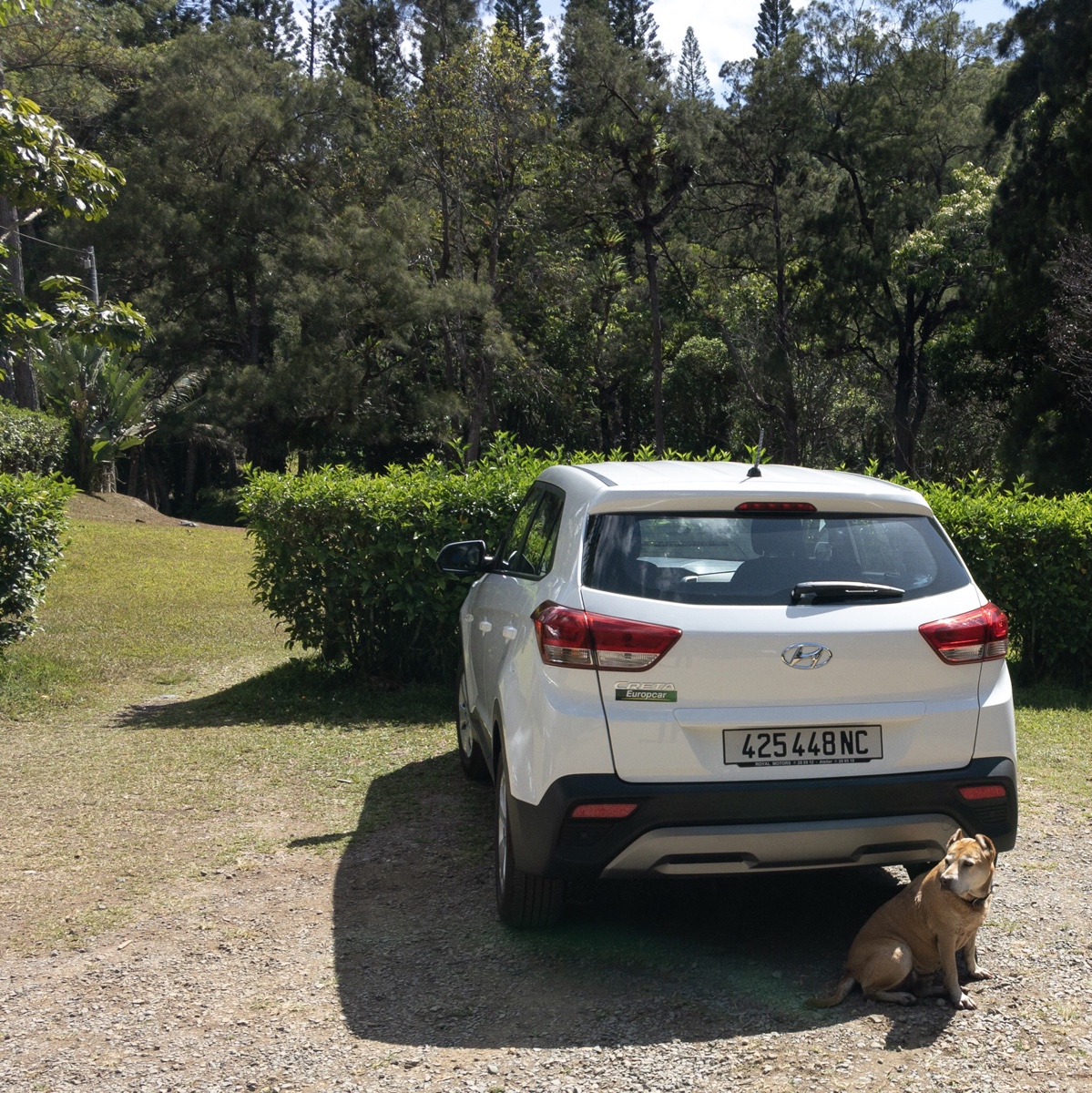
On the above picture, by the way, you can see a typical New Caledonian scene: sun, beautiful trees, a well-maintained picnic area, a rental car (white, fairly new, despite its appearance no 4WD), and a friendly dog with funny ears. Not bad for starters, I’d say.
However, I’m hoping to see even more exciting things over the next five and a half weeks here in this wonderful archipelago! Be assured that I’ll keep you posted, quite literally.
It feels weird (and probably is) to write about the beauty of Hong Kong, while the present of that wonderful city is overshadowed by violent conflicts, and its future not looking very bright either… But not to praise its attractions and to refrain from sharing with you the wonderful experiences I had during the short time of my visit, would that be any better? I really don’t think it would. So let’s continue the praise!
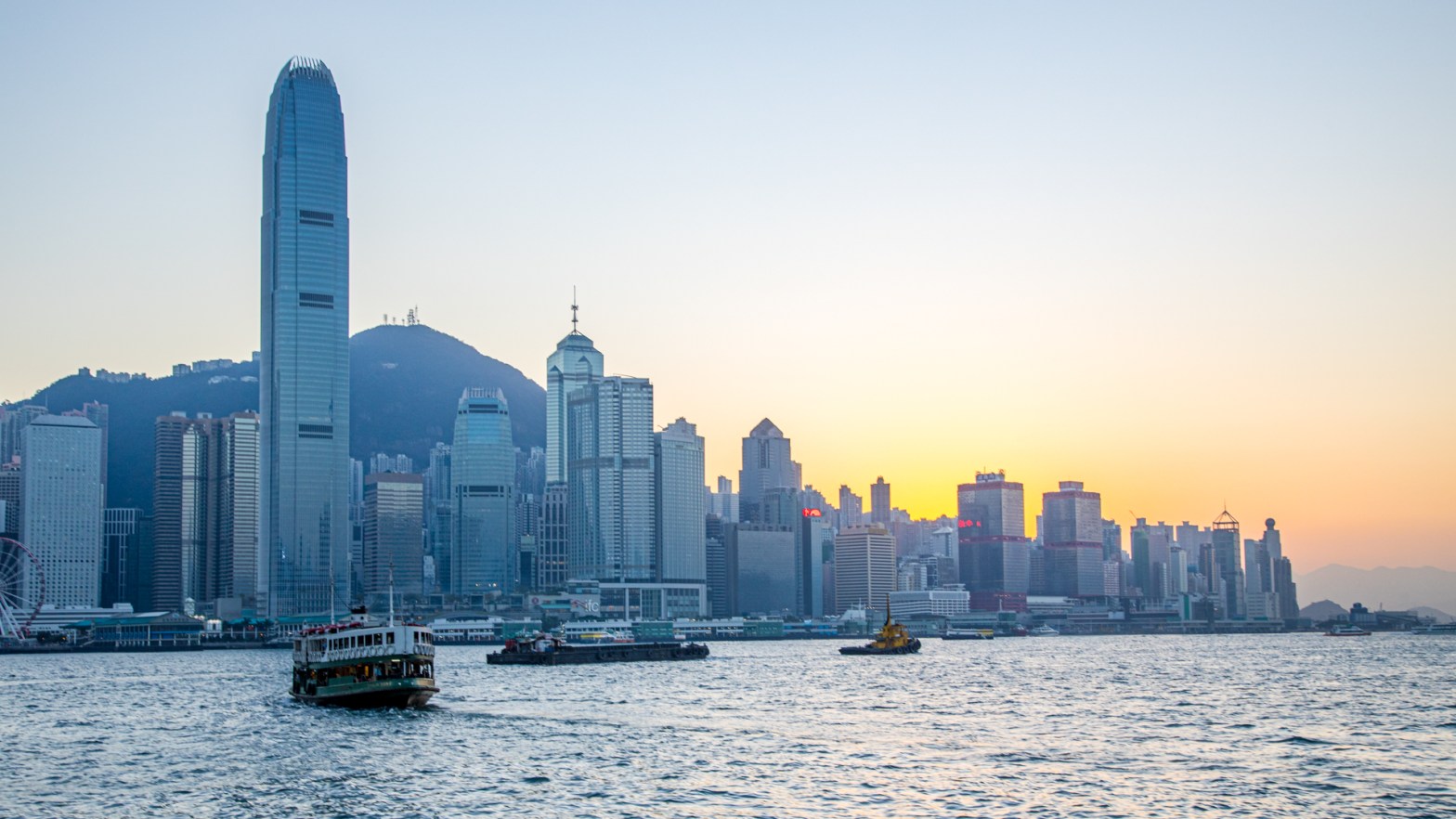
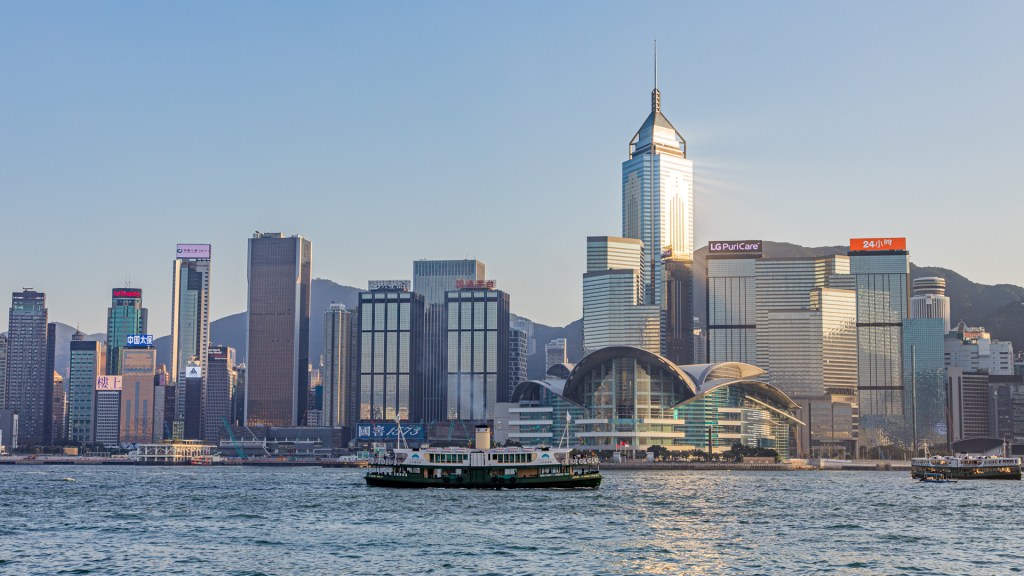
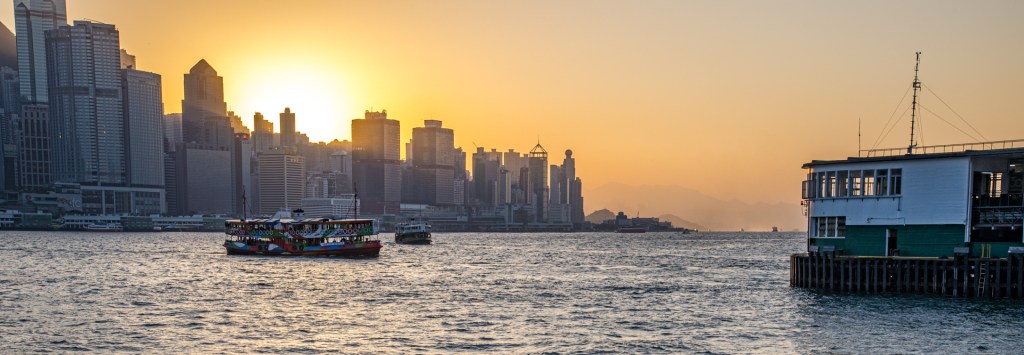
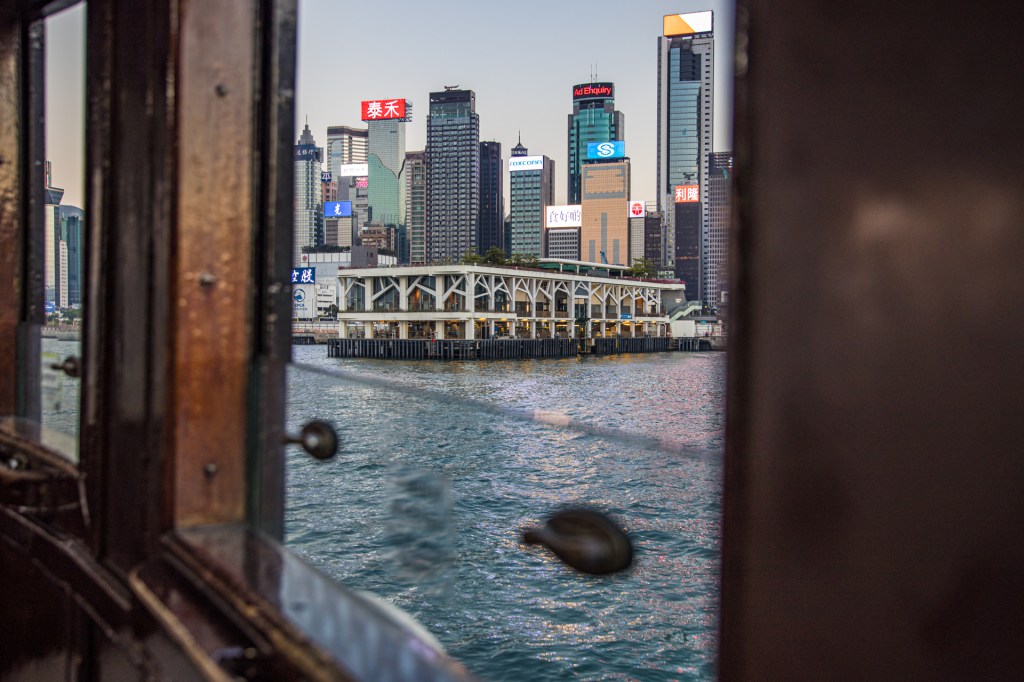
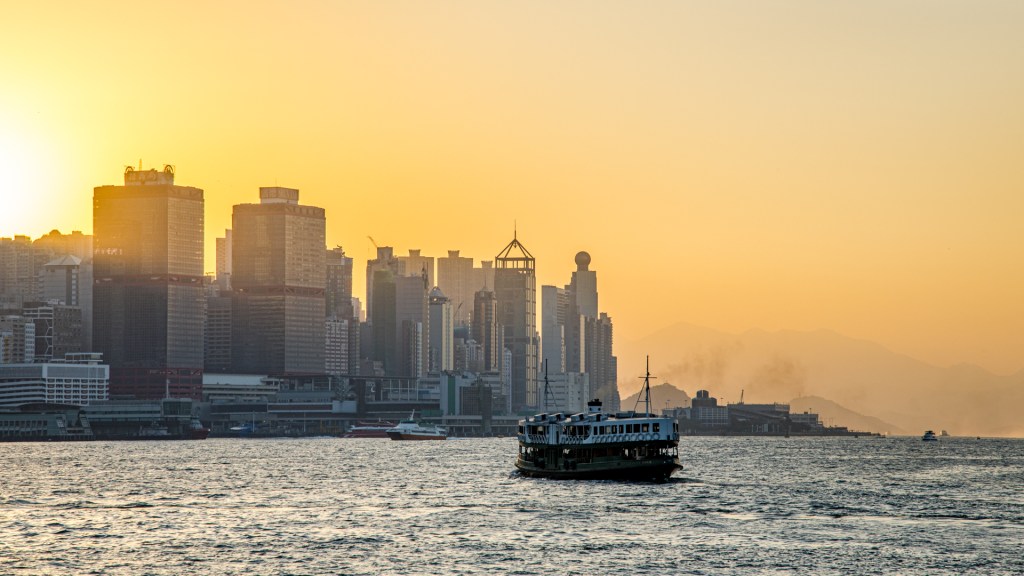
As you already know, I met with my friend Alice on Saturday (as it turned out, the only quiet day of that week). We walked around Victoria Harbour and along the promenade on the northern side (Kowloon), and took the lovely old Star Ferry to cross from one side to the other. I felt very happy and privileged to be there! The scenery was fantastic and the views of the cityscape absolutely breathtaking. And the timing was perfect, too!
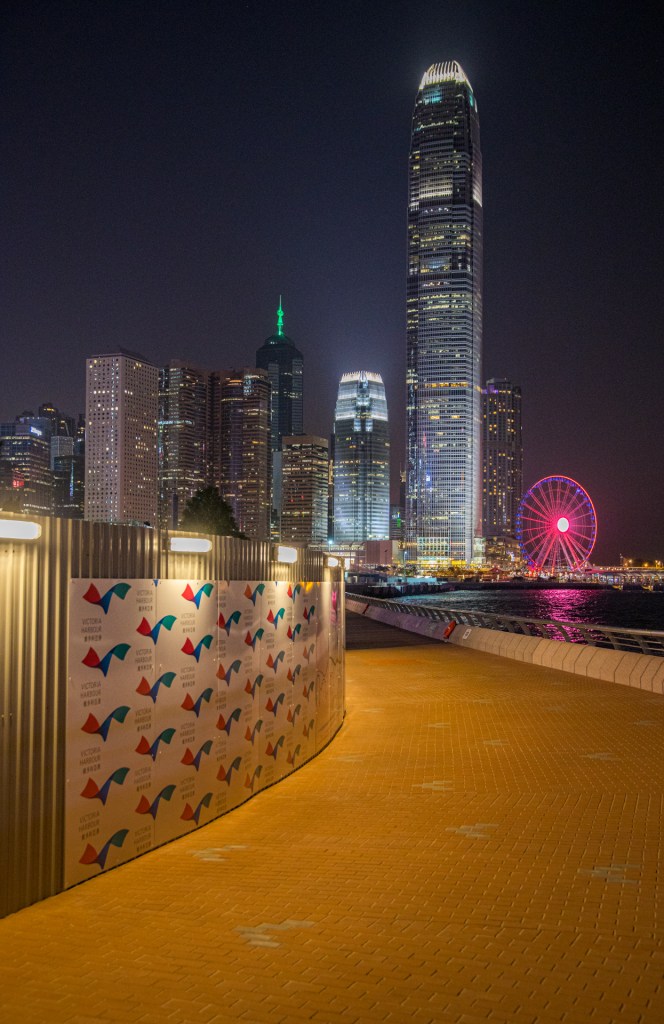
What I have written earlier about the particular light conditions before and especially after sunset also applied here. I was there to see (and capture) the beautiful sunset over Hong Kong Island, and then to witness how evening fell over the fantastic skylines on both sides of the water.
It would have been even better, though, had I taken my tripod with me. For some absurd reason I had decided that day to leave it in the hostel… Well, luckily there were solid walls and fences almost everywhere along the promenades, so I was able to lay down my camera there for the long exposures.
This was all on Saturday evening. My original plan after this first visit was to come back one more time on Sunday, my very last day. This time I would have brought my tripod, of course. But then, already during the early afternoon, I read the news on various websites about violent clashes between protesters and the police on and around the Polytechnic University campus, which lay directly between me (and the airport) and Victoria Harbour… I decided not to take any risks. But I am much hoping to be back some day, if only to have that stupid tripod with me!
Every photographer will tell you that one of the best times of the day for taking pictures is the hour before and especially after sunset. From my own experience I can totally confirm this basic rule and I try to make use of these favourable light conditions whenever I can.
Normally I am somewhere outdoors when I take photos. As most of you know, I live in the Black Forest in Germany which is blessed with beautiful landscapes and great photo locations, sometimes quite far from ‘civilization’. So usually, when I think about dusk, I think of fading light, sunsets, open skies, perhaps seasoned with a few dramatic clouds and all that, dark silhouettes of hills and trees.
Not in Hong Kong!
Already on the day that I arrived and walked from Sham Shui Po MTR station to my hostel in Mei Ho House, I was very impressed by the atmosphere and especially the light that I saw. I immediately liked this residential neighbourhood with its many shops. And I made sure to be back around a similar time of day, this time without all my luggage but with my camera at the ready. And I managed to do that twice.
So what is remarkable about this atmosphere? Well, even at dusk there is plenty of light around, from all kinds of lamps in houses, shops, cars etc. And the streets through which I roamed were always still full of people, making the atmosphere both lively and homely at the same time. I tried to capture all of this with my camera.
I am not sure if this already qualifies as ‘street photography’. And to be honest, I don’t care if it does or not. All I can say is that it was a great pleasure to be there and to somehow be part of it. And even though I am not one to easily talk to people and take pictures of them, I did my best to capture not just the light (and the shadows) but also the people within that scene.
To conclude, I want to mention the fact that I always felt remarkably safe in that neighbourhood. I did not really blend in the crowd, if you know what I mean. My sheer size, my appearance, my camera etc. I was pretty conspicuous, I believe. But nobody seemed to take notice, let alone care about me being there and taking photos. I really felt at home there, for which am very grateful.